Sleep hygiene is not glamorous. There is no single secret or life hack that transforms your sleep overnight. What there is, instead, is a set of habits — boring, consistent, evidence-based habits — that compound over time into genuinely better sleep.
The term "sleep hygiene" was coined by sleep researcher Peter Hauri in the 1970s. It refers to the practices and environmental conditions that support healthy, restorative sleep. Decades of research have validated these principles, and they remain the first-line recommendation from sleep specialists worldwide.
This is a practical checklist. Fifteen habits, grouped by category, that you can start implementing tonight. You do not need to adopt all of them at once. Start with the ones that seem most relevant to your situation, and add more over time.
The point is not perfection. It is building a foundation that makes good sleep the default rather than the exception.
Environment
Your bedroom is where you spend a third of your life. Its setup has a direct impact on how well you sleep.
1. Make Your Room Dark
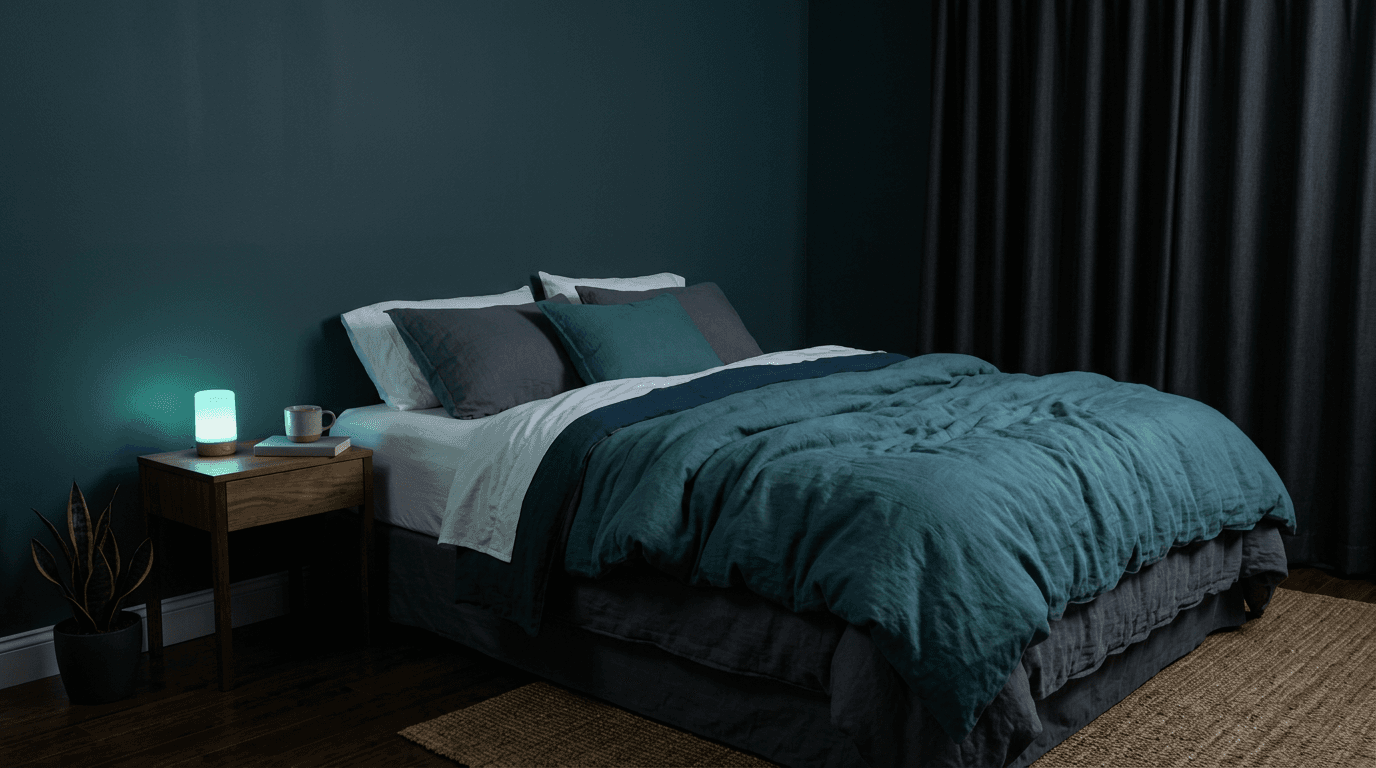
Light is the strongest signal your brain uses to regulate wakefulness. Even small amounts of light — a streetlight through the curtains, a standby LED on a charger, the glow of a digital clock — can suppress melatonin production and reduce sleep quality.
Your eyelids are thinner than you think. Research has shown that light exposure during sleep, even through closed eyes, can increase the time spent in lighter sleep stages at the expense of deep and REM sleep.
Action: Invest in blackout curtains or blinds. Cover or remove any LED indicators in the bedroom. If blackout curtains are not practical, a good quality sleep mask is an effective alternative. The goal is genuine darkness — the kind where you cannot see your hand in front of your face.
2. Cool the Room to 18-20 Degrees Celsius
Your core body temperature needs to drop by approximately 1 degree Celsius to initiate sleep. A cool room facilitates this process. A warm room fights it.
Studies consistently show that the optimal bedroom temperature for sleep is between 18-20 degrees Celsius (65-68 degrees Fahrenheit). Temperatures above 24 degrees Celsius significantly reduce deep sleep and increase nighttime awakenings.
Action: Set your thermostat, fan, or air conditioning to maintain 18-20 degrees Celsius. In warmer climates without air conditioning, use a fan (even pointed at the wall to circulate air), lightweight cotton or linen bedding, and consider a cooling mattress pad. Sleeping in minimal clothing also helps with heat dissipation.
3. Manage Noise
Complete silence is ideal for most people, but not always achievable. Traffic, housemates, pets, and neighbourhood sounds are common disruptors.
What matters is consistency. Sudden noises — a car alarm, a door slam — are more disruptive than constant background noise because they trigger arousal responses. Your brain stays partially alert for unexpected sounds even during deep sleep.
Action: If you cannot control external noise, use earplugs (silicone or foam, both work well) or a white noise machine. White noise, pink noise, or brown noise masks sudden sounds by providing a consistent auditory backdrop. A simple fan can serve double duty as both a cooling and noise solution. Avoid falling asleep to podcasts or music with lyrics — these engage the language centres of your brain.
4. Invest in Comfortable Bedding
This sounds obvious, but many people tolerate a mediocre mattress and pillows for years. Your mattress and pillow directly affect spinal alignment, pressure points, and temperature regulation.
There is no single "best" mattress. Medium-firm mattresses tend to perform well in research, but individual comfort matters more than any universal recommendation.
Action: If your mattress is more than 7-10 years old or you wake with aches and stiffness, consider replacing it. Your pillow should keep your neck in neutral alignment — not bent up or down. Wash sheets weekly. Clean bedding is associated with better subjective sleep quality.
Timing
When you sleep matters almost as much as how long you sleep.
5. Maintain a Consistent Schedule
This is the most impactful sleep hygiene habit. Going to bed and waking up at roughly the same time every day — including weekends — aligns your circadian rhythm and improves the efficiency of every sleep stage.
The temptation to "catch up" on weekends by sleeping in is understandable but counterproductive. Shifting your wake time by 2-3 hours on weekends creates a form of jet lag called "social jet lag." Your circadian clock drifts, making Monday mornings harder and Sunday nights sleepless.
Action: Choose a bedtime and wake time that allows for 7-9 hours of sleep and stick to it within a 30-minute window, seven days a week. Set a reminder 30-60 minutes before bedtime to start winding down. If you need to adjust your schedule, shift by 15-30 minutes per day rather than making large jumps.
6. Build a Wind-Down Routine
Your brain does not have an off switch. It needs a transition period between the stimulation of waking life and the calm of sleep. A consistent pre-sleep routine serves as that transition — a series of low-stimulation activities that signal to your brain that sleep is approaching.
The content of the routine matters less than the consistency. Your brain learns to associate the routine with sleep onset.
Action: Design a 20-30 minute wind-down routine and follow it every night. Options include reading (physical book, not a screen), gentle stretching, a warm shower or bath, listening to calm music, or quiet conversation. The key is doing the same things in the same order so your brain recognises the pattern.
7. Limit Naps to 20 Minutes Before 3 PM
Naps can be beneficial when used strategically, but poorly timed or excessively long naps can sabotage nighttime sleep.
Long naps (over 30 minutes) often include deep sleep, which creates sleep inertia — that groggy, disoriented feeling when you wake up. They also reduce your homeostatic sleep drive (the pressure to sleep that builds during waking hours), making it harder to fall asleep at your normal bedtime.
Naps after 3 PM are particularly problematic because they reduce sleep pressure right when you need it to build toward bedtime.
Action: If you need to nap, keep it to 20 minutes and set an alarm. Nap before 3 PM. A short nap in the early afternoon (12-2 PM) aligns with a natural dip in alertness and is least likely to interfere with nighttime sleep. If you find yourself needing daily naps, investigate whether your nighttime sleep is sufficient.
Nutrition
What you consume and when you consume it affects sleep more than most people realise.
8. Set a Caffeine Cutoff
Caffeine has a half-life of 5-6 hours, meaning half the caffeine from a 3 PM coffee is still in your system at 9 PM. A quarter remains at 3 AM. Even if you can fall asleep with caffeine in your system, it reduces deep sleep — the most restorative stage.
Many people underestimate how many sources of caffeine they consume. Coffee is obvious, but tea, energy drinks, pre-workout supplements, dark chocolate, and some medications also contain caffeine.
Action: Set a firm caffeine cutoff 8-10 hours before bedtime. If you sleep at 10 PM, no caffeine after 12-2 PM. Pay attention to all caffeine sources, not just coffee. If you are particularly sensitive (some people metabolise caffeine more slowly due to genetic variation), you may need an even earlier cutoff.
9. Limit Alcohol
Alcohol is the most misunderstood sleep substance. It makes you fall asleep faster, which people interpret as "helping" sleep. In reality, alcohol suppresses REM sleep, fragments the second half of the night, elevates heart rate, and significantly reduces deep sleep quality.
The effect is dose-dependent. One drink has a modest impact. Three or more drinks can reduce sleep quality by 40% or more. For a deeper look at this topic, see our guide on how alcohol affects recovery.
Action: If you drink alcohol, stop at least 3-4 hours before bed and limit to 1-2 drinks. If sleep quality is a priority, experiment with alcohol-free weeks and compare your sleep data. The difference in HRV and resting heart rate is usually visible within a single night.
10. Eat a Light Evening Meal
A large, heavy meal close to bedtime raises your core body temperature (through the thermic effect of food), activates your digestive system, and can cause acid reflux — all of which impair sleep quality.
On the other hand, going to bed hungry can also disrupt sleep. Low blood sugar triggers cortisol release, which is stimulating.
Action: Eat your main evening meal at least 2-3 hours before bed. If you are hungry closer to bedtime, have a small, protein-rich snack (Greek yoghurt, a handful of nuts, cottage cheese). Avoid spicy, acidic, or very fatty foods in the final 2-3 hours before sleep.
11. Balance Hydration
Dehydration can cause nighttime awakenings and discomfort. But drinking too much liquid close to bedtime means waking up to use the bathroom, which fragments your sleep.
Action: Stay well-hydrated during the day. Begin tapering fluid intake 2-3 hours before bed. If you are thirsty before sleep, take small sips rather than drinking a full glass. If you consistently wake up to urinate more than once per night, talk to a doctor — this can sometimes indicate a medical issue beyond simple hydration.
Habits
Daily habits outside the bedroom affect what happens inside it.
12. No Screens 30 Minutes Before Bed
This is partly about blue light (which suppresses melatonin) and partly about stimulation. Scrolling social media, reading the news, or watching engaging content activates your brain in ways that are incompatible with winding down.
The blue light effect is real but sometimes overstated. The cognitive stimulation of screen content is arguably the bigger problem. A boring article on a dimmed screen is less disruptive than an exciting TV show, but both are worse than no screen at all.
Action: Put your phone on the charger in another room 30 minutes before bed. If you use your phone as an alarm, buy a basic alarm clock — they cost almost nothing. If you must use a screen, enable night mode, reduce brightness to minimum, and choose boring content. Better yet, replace screen time with reading a physical book.
13. Journal or Brain Dump
Racing thoughts are one of the most common barriers to falling asleep. Your brain rehearses worries, replays conversations, and generates to-do lists precisely when you want it to shut down.
Writing these thoughts down externalises them. Research has shown that spending 5 minutes writing a to-do list for the next day reduces sleep onset time by an average of 9 minutes compared to writing about completed activities.
Action: Keep a notebook beside your bed (not a phone app — that defeats the screen-free purpose). Before bed, spend 5 minutes writing down anything on your mind: tasks for tomorrow, worries, ideas, things you are grateful for. The specific format does not matter. The act of writing it down tells your brain it does not need to hold onto it.
14. Practice Breathing Exercises
Controlled breathing activates the parasympathetic nervous system (rest and digest) and deactivates the sympathetic nervous system (fight or flight). This physiological shift prepares your body for sleep.
Two techniques with evidence behind them:
- 4-7-8 breathing: Inhale through the nose for 4 seconds. Hold for 7 seconds. Exhale through the mouth for 8 seconds. Repeat 3-4 cycles.
- Box breathing: Inhale for 4 seconds. Hold for 4 seconds. Exhale for 4 seconds. Hold for 4 seconds. Repeat 4-6 cycles.
Action: Choose one breathing technique and practice it as the final step of your wind-down routine. Consistency matters — the more you associate the breathing pattern with sleep, the more effectively it will trigger relaxation over time.
15. Get Morning Sunlight
This seems counterintuitive in a list about sleep, but morning light exposure is one of the most powerful tools for improving nighttime sleep.
Bright light in the first 30-60 minutes after waking anchors your circadian rhythm, setting the clock that determines when you will feel sleepy 14-16 hours later. Morning sunlight exposure has been shown to improve sleep onset time, increase deep sleep, and improve overall sleep quality.
The light needs to be bright — outdoor light is 10-100 times brighter than indoor lighting, even on a cloudy day. Artificial indoor lighting is generally not bright enough to set the circadian clock effectively.
Action: Spend 10-15 minutes outside within the first hour of waking. You do not need direct sunlight — overcast sky is sufficient. Walk, drink your coffee outside, or sit on a balcony. If you wake before sunrise (especially in winter), a 10,000 lux light therapy box can substitute for natural light.
How to Use This Checklist With Sleep Tracking
Implementing all 15 habits at once is overwhelming and unnecessary. A better approach is to use sleep tracking data to identify which habits will have the most impact for you.
Start by tracking your sleep for 1-2 weeks with your current habits. Note your baseline sleep score, deep sleep minutes, and any patterns you notice.
Then pick 2-3 habits from this list that address your most obvious issues:
- Waking up during the night? Focus on environment (darkness, noise, temperature) and nutrition (alcohol, caffeine, hydration).
- Difficulty falling asleep? Focus on timing (consistency, wind-down routine) and habits (screens, breathing, journalling).
- Low deep sleep? Focus on environment (temperature) and nutrition (caffeine, alcohol).
- Waking up tired despite adequate hours? Focus on timing (consistency) and morning light.
Penng tracks sleep stages (light, deep, REM), sleep score (0-100), overnight HRV, and resting heart rate. Use this data to evaluate whether your changes are working. Give each change 1-2 weeks before judging its effect, and change one variable at a time so you can attribute improvements correctly.
The goal is not a perfect sleep score every night. It is an upward trend over weeks and months, driven by habits that become automatic.
Frequently Asked Questions
What is the most important sleep hygiene habit?
Maintaining a consistent sleep schedule is consistently ranked as the single most impactful sleep hygiene practice. Going to bed and waking up at the same time every day — including weekends — aligns your circadian rhythm and improves the quality of every sleep stage. If you only change one thing, make it this.
How long does it take for sleep hygiene changes to work?
Most changes take 1-2 weeks to show measurable effects in sleep data. Some habits, like reducing caffeine or alcohol, can produce noticeable improvements within a few days. Others, like establishing a consistent schedule, may take 2-4 weeks as your circadian rhythm adjusts. Be patient and track the data.
Is it bad to read in bed?
Reading a physical book in bed is generally fine and can be a beneficial part of a wind-down routine. The issue is with screens — e-readers with backlighting, tablets, and phones emit blue light and provide access to stimulating content. If you read on a backlit device, use night mode and keep the brightness low. A physical book is always the better option.
Can I fix bad sleep hygiene in one night?
You can start implementing changes immediately, but the full benefit accumulates over time. Your circadian rhythm takes days to weeks to adjust. Your body needs to learn the new associations between your routine and sleep. Think of sleep hygiene as a practice, not a quick fix. One night of perfect habits will not erase weeks of poor ones, but every good night builds momentum.
Should I stay in bed if I cannot fall asleep?
No. If you have been lying in bed for more than 20 minutes without falling asleep, get up and do something quiet and low-stimulation in dim light — reading, gentle stretching, breathing exercises. Return to bed when you feel sleepy. This prevents your brain from associating the bed with wakefulness, which can create a cycle of insomnia.
Ready to see where your sleep habits stand? Take the free quiz at penng.ai/quiz and get personalised recommendations in 2 minutes.