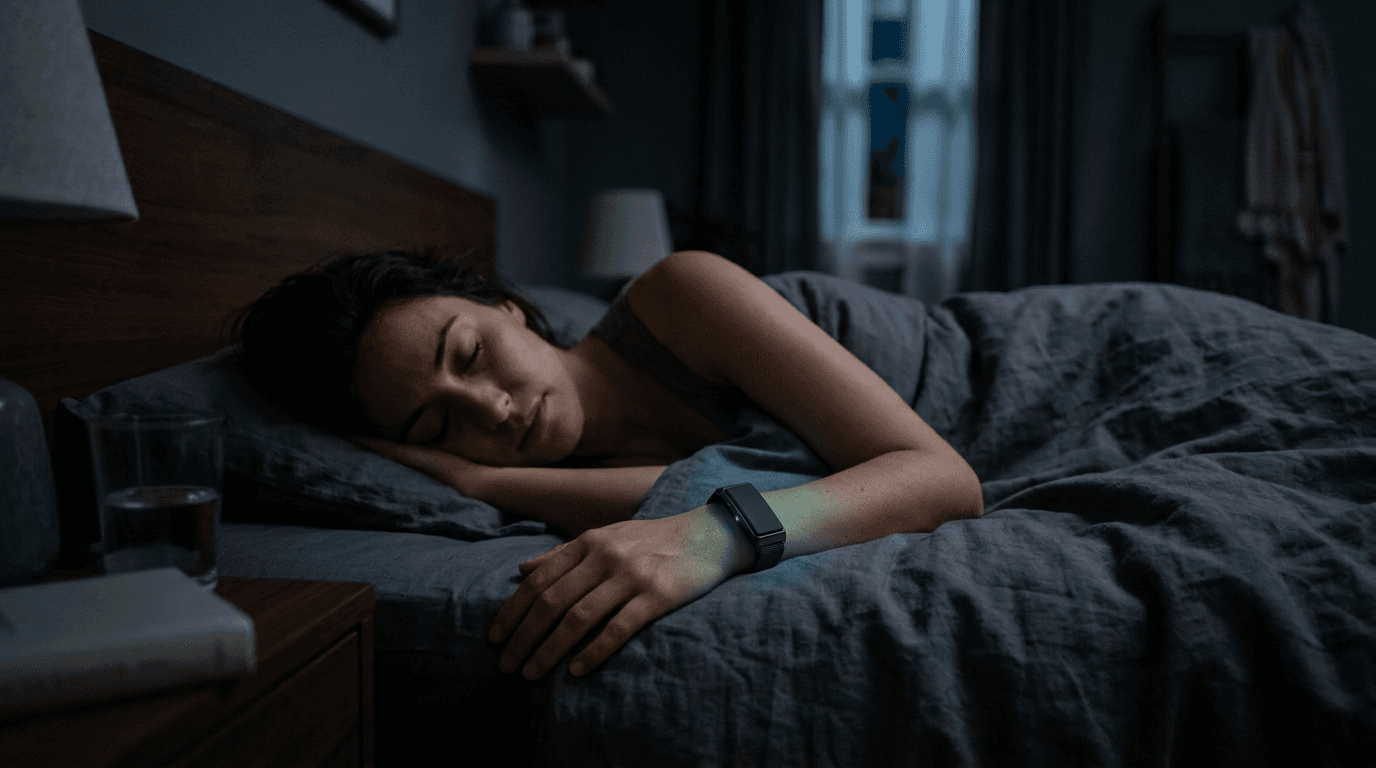
Millions of people check their sleep data every morning. They see a sleep score, a breakdown of light, deep, and REM stages, and a neatly coloured chart of their night.
But how does a small device on your wrist or finger actually know what your brain was doing while you were unconscious?
The answer involves some clever engineering, reasonable assumptions, and important limitations that most companies do not talk about.
This is a straightforward look at how sleep tracking wearables work, what they get right, what they get wrong, and how to use the data in a way that actually helps.
The Gold Standard: Polysomnography
Before we talk about wearables, we need to understand what perfect sleep measurement looks like.
Polysomnography (PSG) is the clinical sleep study. It is conducted in a sleep lab and involves multiple sensors attached to your body:
- EEG (electroencephalogram): Electrodes on your scalp measure brain wave activity. This is the primary method for determining sleep stages. Each stage — NREM1, NREM2, deep sleep, and REM — has a distinct brain wave pattern.
- EOG (electrooculogram): Electrodes near the eyes detect eye movements. Rapid eye movements are the defining feature of REM sleep.
- EMG (electromyogram): Sensors on the chin and legs measure muscle activity. Muscle atonia (paralysis) during REM is a key diagnostic marker.
- ECG/EKG: Heart rate and rhythm monitoring.
- Respiratory sensors: Airflow, chest and abdominal movement, and blood oxygen levels.
- Pulse oximetry: Blood oxygen saturation.
A trained sleep technician scores the recording in 30-second segments called epochs, classifying each as wake, NREM1, NREM2, NREM3 (deep sleep), or REM.
PSG is as accurate as sleep measurement gets. It is also expensive (thousands of Rands per night), uncomfortable (sleeping with wires glued to your head), and impractical for regular use. You cannot do a PSG every night. This is why consumer wearables exist.
How Consumer Wearables Track Sleep
Consumer sleep trackers do not measure brain waves. They cannot. There are no EEG electrodes on your wrist or finger. Instead, they use two primary sensors to infer what your brain is doing based on what your body is doing.
Sensor 1: Accelerometer
An accelerometer measures movement in three dimensions. It detects when you shift position, twitch, roll over, or lie completely still.
The basic principle is simple: when you are asleep, you move less than when you are awake. And different sleep stages are associated with different levels of movement:
- Awake: Frequent, large movements.
- Light sleep (NREM1/NREM2): Some movement, periodic position changes.
- Deep sleep (NREM3): Very little movement. Your muscles are fully relaxed.
- REM sleep: Minimal body movement (due to muscle atonia), though small twitches can occur.
Early sleep trackers relied almost entirely on accelerometers. They were essentially fancy movement detectors. These devices could tell that you were asleep versus awake with reasonable accuracy, but their ability to distinguish between sleep stages was poor.
Modern wearables still use accelerometers, but they are supplemented by a far more informative sensor.
Sensor 2: PPG (Photoplethysmography)
PPG is the optical heart rate sensor — the green light you see glowing on the back of your wearable. It works by shining light into your skin and measuring how much light is reflected back. Blood absorbs light, so the sensor can detect changes in blood volume with each heartbeat.
From this signal, wearables extract:
- Heart rate. Your heart rate changes predictably across sleep stages. It drops during light sleep, reaches its lowest point during deep sleep, and becomes more variable during REM.
- Heart rate variability (HRV). The variation in time between heartbeats. HRV tends to be highest during deep sleep (reflecting parasympathetic dominance) and more irregular during REM sleep. HRV patterns are a strong signal for distinguishing between sleep stages.
- Respiratory rate (some devices). Some wearables derive breathing rate from the PPG signal by detecting respiratory-related variations in the pulse wave. Not all devices offer this.
- SpO2 (blood oxygen). Some wearables include a red/infrared LED alongside the green one to estimate blood oxygen levels during sleep.
The combination of movement data and cardiac data gives algorithms much more to work with. A period of low movement combined with low heart rate and high HRV is very likely deep sleep. Low movement combined with variable heart rate and lower HRV is more consistent with REM sleep.
The Algorithm Layer
Raw sensor data is meaningless without algorithms to interpret it. Every wearable company has proprietary algorithms that take accelerometer and PPG data and classify each period of sleep into a stage.
These algorithms are typically trained using machine learning. The process works roughly like this:
- Recruit study participants to wear the consumer device while simultaneously undergoing a PSG study.
- Use the PSG data as the ground truth — this is the "correct" answer for what sleep stage occurred at each moment.
- Train a machine learning model to match the wearable's sensor data to the PSG classifications.
- Validate the model against a separate group of participants to check accuracy.
The quality of these algorithms varies between companies. Companies that have invested more in validation studies, used larger and more diverse participant pools, and iterated over more product generations tend to produce more accurate results.
How Accurate Are Consumer Sleep Trackers?
This is the question everyone asks. The answer is nuanced.
What They Get Right
Total sleep time. Most modern wearables estimate total sleep time within 15-30 minutes of PSG on average. This is good enough to be useful. If your wearable says you slept 6 hours and 45 minutes, you probably slept somewhere between 6 hours 15 minutes and 7 hours 15 minutes.
Sleep vs. wake detection. Consumer wearables are generally good at distinguishing sleep from wakefulness. Sensitivity (correctly identifying sleep) is typically above 90%. This means they rarely miss that you were asleep.
Trends over time. Even if the absolute numbers on any given night are slightly off, the trends are reliable. If your average deep sleep drops from 80 minutes to 50 minutes over three weeks, that pattern is meaningful regardless of whether the absolute numbers are perfectly accurate.
What They Get Wrong
Sleep stage classification. This is where accuracy drops. Studies comparing consumer wearables to PSG generally show 70-80% epoch-by-epoch agreement for sleep staging. That sounds reasonable until you consider what it means in practice.
For a typical 8-hour night (960 thirty-second epochs), 70-80% agreement means 192-288 epochs could be misclassified. That is roughly 1.5 to 2.5 hours of incorrectly labelled sleep stages.
Common errors include:
- Light sleep misclassified as deep sleep (or vice versa). The cardiac signatures of NREM2 and NREM3 overlap, making them difficult to distinguish without EEG data.
- REM misclassified as light sleep. Since the accelerometer cannot directly detect eye movements, REM detection relies heavily on heart rate patterns, which can be ambiguous.
- Brief awakenings missed. Short awakenings (under 1-2 minutes) are often classified as light sleep rather than wake, leading to slightly inflated total sleep time.
Specificity for wake. While wearables are good at detecting sleep, they are less good at detecting wakefulness during the night. If you lie still in bed but are actually awake, the device may count that as light sleep. This inflates total sleep time.
What Affects Accuracy
Several factors can make your wearable's sleep data more or less reliable:
- Fit. A loose wearable produces a noisier PPG signal. Heart rate and HRV estimates become less reliable, which degrades sleep staging accuracy. The device should sit snugly but not uncomfortably.
- Movement during sleep. People who move a lot during sleep can confuse accelerometer-based algorithms. The wearable may misinterpret frequent movements as awakenings.
- Sleep disorders. Conditions like sleep apnoea, restless leg syndrome, or periodic limb movement disorder create unusual patterns that consumer algorithms are not designed to handle. If you suspect a sleep disorder, see a doctor — a wearable is not a diagnostic tool.
- Skin tone and tattoos. PPG sensors work by reflecting light off blood vessels. Very dark skin, thick tattoos over the sensor area, or poor circulation can affect signal quality.
- Alcohol and medication. Substances that alter heart rate patterns can confuse sleep staging algorithms. Your wearable may show unusual staging on nights when you drink or take certain medications.
Comparing Approaches: Wrist vs. Ring vs. Other
Different form factors have different strengths for sleep tracking.
Wrist-Based Trackers (Penng, WHOOP, Apple Watch, Fitbit)
Wrist-based devices benefit from a large, flat sensor surface and secure fit. The wrist is also a convenient location for continuous wear. Movement detection is good because wrist movements are pronounced.
The downside is that PPG accuracy can be lower on the wrist than on the finger because the wrist has more tendons, bones, and variable tissue between the sensor and the blood vessels.
Ring-Based Trackers (Oura Ring)
Rings sit on the finger, which has more superficial blood vessels and less tissue interference. This can produce a cleaner PPG signal. Some studies have shown marginally better HRV measurement from finger-based sensors.
The trade-off is that rings are easier to remove (some people take them off unconsciously during sleep), the sensor surface is smaller, and ring sizing needs to be precise — a ring that is too loose produces poor data.
Under-Mattress Trackers (Withings Sleep Analyzer)
These devices use ballistocardiography (detecting body vibrations caused by heartbeats) and movement sensors placed under your mattress. They require no wearable at all.
Accuracy for sleep staging is generally lower than wrist or ring devices because the signal is less direct. However, they are useful for people who cannot tolerate wearing anything to bed.
The Honest Answer
No consumer device approaches the accuracy of PSG for sleep staging. The differences between wrist, ring, and other form factors are relatively small compared to the gap between all of them and clinical measurement. Choose based on comfort and the overall feature set rather than marginal accuracy differences.
How Penng Tracks Sleep
Penng uses a PPG optical heart rate sensor and a three-axis accelerometer to track sleep. The band is worn on the wrist and records continuously throughout the night.
In the morning, the app displays:
- Total sleep time and time in bed
- Sleep stages: Light, deep, and REM with a timeline view
- Sleep score: 0-100, reflecting duration, staging, and physiological signals
- Overnight HRV: Measured during sleep and displayed as a morning value
- Resting heart rate: Your lowest heart rate during sleep
- SpO2: Blood oxygen percentage
Because Penng is a screen-free wearable, there is no display on the band itself. All data is reviewed in the app. This design choice means nothing disturbs your sleep — no notifications, no glowing screen, no vibrations (unless you set a silent alarm).
One practical advantage of Penng's approximately 21-day battery life is data continuity. Wearables that need charging every 3-5 days inevitably create gaps in sleep data, often on the nights when you forget to charge during the day. Longer battery life means fewer missed nights and more reliable trend data.
Penng does not claim medical-grade accuracy. Like every consumer wearable, it provides estimates. The value is in consistent tracking over time — identifying patterns, spotting the effects of behaviour changes, and connecting sleep data to your recovery score.
How to Use Sleep Tracking Data Effectively
Knowing the limitations of sleep trackers is not a reason to stop using them. It is a reason to use them more intelligently.
Focus on Trends, Not Single Nights
A single night's sleep staging data is an estimate. It might be 80% accurate. It might be 70%. On any given night, the absolute numbers could be off.
But trends across weeks and months are far more reliable. If your weekly average deep sleep drops from 90 minutes to 55 minutes over three weeks, that is a real signal. The direction and magnitude of the trend are meaningful even if the absolute numbers have some error.
Use Your Data as a Feedback Tool
The most valuable use of sleep tracking is as a feedback mechanism for behaviour changes:
- Changed your caffeine cutoff? Compare your average deep sleep for the two weeks before and after.
- Started exercising in the morning instead of the evening? Check whether your sleep score trends upward.
- Reduced alcohol on weekdays? Compare weekday HRV and sleep staging to your previous pattern.
The wearable does not need to be perfectly accurate for these comparisons to work. It just needs to be consistently measuring in the same way, so that changes in the data reflect changes in your actual sleep.
Do Not Chase Perfect Numbers
Some people become anxious about their sleep score, checking it first thing in the morning and feeling worse if the number is low. This is counterproductive. Sleep anxiety is itself a cause of poor sleep.
Use the data as information, not as a judgement. A low sleep score on one night is not a crisis. A pattern of declining scores over weeks is worth investigating.
Know When to See a Doctor
Consumer sleep trackers cannot diagnose sleep disorders. If you consistently get poor sleep scores despite good sleep habits, if your wearable shows significant SpO2 drops during the night, or if you experience excessive daytime sleepiness, snoring, or gasping during sleep, see a sleep specialist. A clinical PSG can identify conditions that no consumer device can detect.
Frequently Asked Questions
How accurate are wearable sleep trackers compared to a sleep study?
Consumer wearables agree with clinical polysomnography about 70-80% of the time for sleep staging on a per-epoch basis. Total sleep time estimates are typically within 15-30 minutes. They are good enough for tracking trends and identifying patterns but are not a substitute for clinical sleep studies when diagnosing sleep disorders.
Can a wearable tell the difference between light and deep sleep?
Yes, but with limitations. Wearables use heart rate patterns and movement to estimate sleep stages. Deep sleep is characterised by low heart rate, high HRV, and minimal movement. Light sleep shows moderate heart rate with more movement. The distinction is imperfect because the cardiac signatures of light and deep sleep overlap, particularly during the transitions between stages.
Which is more accurate for sleep tracking — a wrist band or a ring?
The differences are marginal. Rings may produce a slightly cleaner PPG signal because fingers have more superficial blood vessels, but wrist-based devices have larger sensor surfaces and more secure fit. In practice, the algorithmic quality of the specific device matters more than the form factor. Choose based on comfort and overall features.
Does wearing a wearable to bed affect sleep quality?
Most people adapt within a few nights. Screen-free wearables like Penng produce no light, notifications, or vibrations during sleep, which minimises disruption. If you find a wearable uncomfortable, try adjusting the fit — snug enough for good sensor contact but not so tight it restricts circulation. Some people prefer rings for sleep comfort.
Should I trust my wearable's sleep data if it seems wrong?
A single night of unusual data is not necessarily inaccurate — your sleep genuinely varies night to night. However, if your wearable consistently shows results that contradict how you feel (showing good sleep when you feel exhausted, or vice versa), consider checking the fit, ensuring the device is updated, or comparing with another data source. Persistent disconnect between data and experience may indicate a fit issue, a sleep disorder, or limitations of that particular device's algorithms.
Curious what your sleep data reveals about your recovery? Take the free quiz at penng.ai/quiz and find out in 2 minutes.