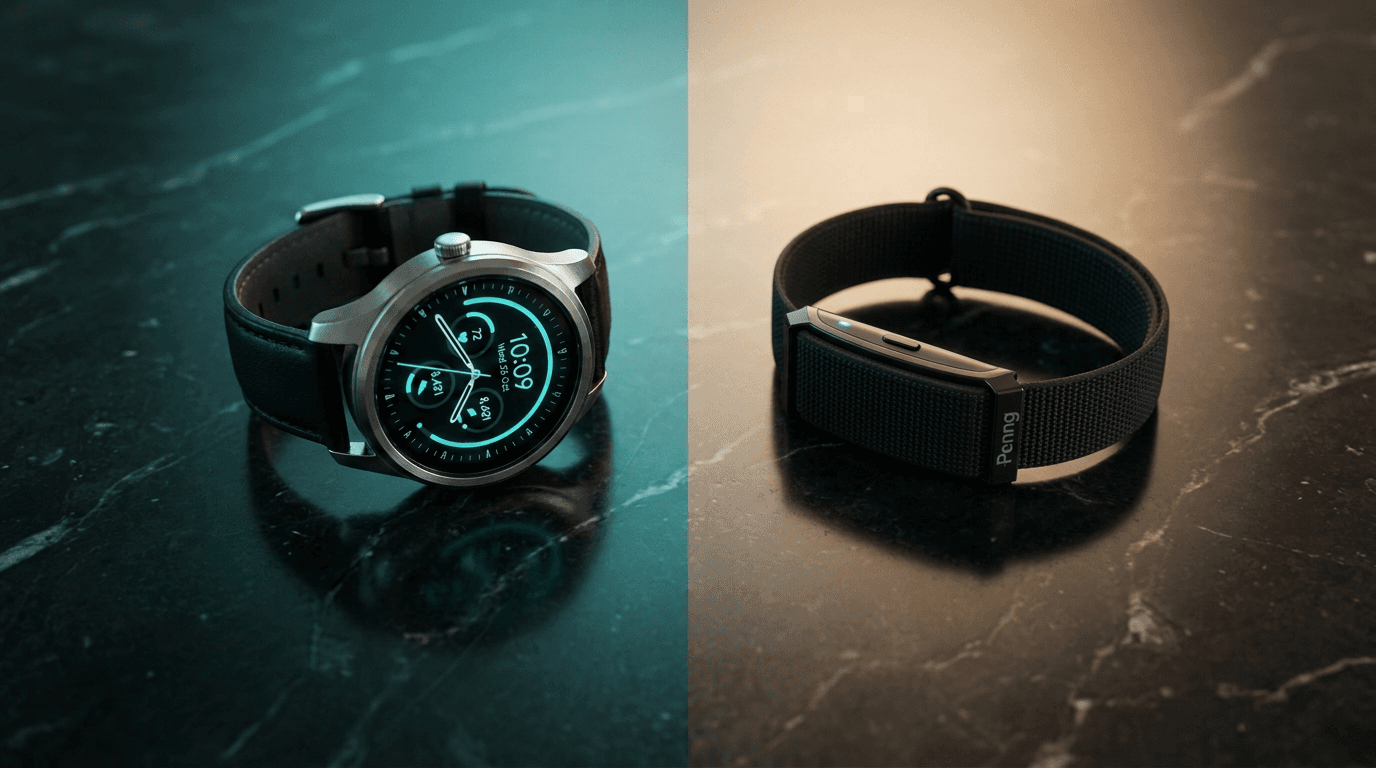
Samsung has been steadily building one of the most health-focused smartwatch platforms in the industry. The Galaxy Watch line, particularly the Galaxy Watch Ultra and Galaxy Watch 7, pack features like BIA body composition analysis, skin temperature sensing, and blood pressure monitoring (in supported markets) into a polished smartwatch package.
Penng takes the opposite approach. A screen-free band that skips the smartwatch features entirely and focuses on recovery, strain, sleep, and AI-powered food tracking. No screen to crack. No apps to install. No notifications to manage.
Both claim to help you live healthier. But they go about it in very different ways.
Samsung's Health Ambitions
Samsung has positioned itself as the health-first smartwatch brand. While Apple focuses on lifestyle integration and Garmin targets athletes, Samsung has leaned into medical-adjacent features:
- BIA body composition - The Galaxy Watch can estimate body fat percentage, skeletal muscle mass, body water, and BMI using bioelectrical impedance analysis through sensors on the watch back and side button. You touch two fingers to the side button and get a body composition reading in about 15 seconds.
- Blood pressure monitoring - Available in some markets (South Korea primarily, expanding gradually). Requires calibration with an actual blood pressure cuff every 28 days.
- Skin temperature - Continuous tracking, useful for cycle tracking and illness detection.
- ECG - Single-lead electrocardiogram for detecting irregular heart rhythms.
- SpO2 - Blood oxygen monitoring.
- Sleep tracking - Sleep stages, sleep score, snoring detection (using the phone's microphone), blood oxygen during sleep.
- Heart rate - Continuous optical monitoring with high/low heart rate alerts.
- Advanced running metrics - VO2 max, running form, asymmetry detection (on newer models with the 3-in-1 BioActive sensor).
On paper, this is one of the most comprehensive health sensor packages in any consumer wearable. Samsung is clearly investing in the medical wearable space.
Penng's Health Focus
Penng measures fewer things but integrates them into a more actionable daily framework:
- Recovery score - 0-100% with green/yellow/red traffic light. Based on overnight HRV, resting heart rate, sleep quality, and SpO2.
- Strain score - 0-100 that accumulates throughout the day based on physical exertion.
- Sleep score - 0-100 with Light, Deep, and REM stage breakdown.
- HRV - Overnight heart rate variability displayed as a morning value.
- Resting heart rate - Tracked continuously, displayed in app.
- SpO2 - Blood oxygen percentage.
- AI food tracking - Five input methods: photo, barcode scan, text description, voice, and nutrition label photo.
- 109+ workout types - Manually started and ended.
Penng does not have body composition analysis, skin temperature, blood pressure, ECG, or auto workout detection. These are real gaps. If you want to track body composition from your wrist, Samsung does that and Penng doesn't.
But the question isn't just "which has more sensors." It's "which data do you actually use every day to make better decisions?"
Recovery: Energy Score vs Recovery Score
Samsung introduced the Energy Score in its Samsung Health platform, which functions as a recovery/readiness indicator. It draws from sleep quality, sleep consistency, activity, heart rate patterns, and stress levels to give you a daily energy reading.
Penng's Recovery Score similarly synthesises overnight HRV, resting heart rate, sleep quality, and SpO2 into a 0-100% score with traffic-light colour coding for immediate interpretation.
Both are useful for guiding daily training intensity. Samsung's Energy Score is relatively new and is still being refined. Penng's approach is more opinionated. The traffic-light system makes the guidance immediate: green means go, red means rest.
Crucially, Penng also tracks Strain on a 0-100 scale throughout the day. Samsung tracks activity through step goals, Active Zone-style minutes, and workout summaries, but doesn't consolidate daily exertion into a single strain number. The recovery-strain pairing is Penng's core value proposition. It answers two questions every day: "How recovered am I?" and "How hard have I pushed?" The relationship between those two numbers tells you whether you're training sustainably.
Verdict: Penng's recovery-strain framework is more focused and actionable. Samsung has more data points but doesn't consolidate them into as clean a daily decision framework.
Food Tracking
Samsung has Samsung Food (formerly Whisk), a recipe and meal planning app that integrates with Samsung Health. You can log meals, search a food database, and track basic nutrition. The integration is reasonable but the food tracking experience is fundamentally manual. You search, select, estimate portions, and log. It's the same approach every food app has used for years.
Penng's food tracking is AI-powered and built directly into the health app:
- Photo - Photograph your plate and Gemini Vision AI identifies food and estimates macros.
- Barcode scan - Scan packaged food for nutrition data from OpenFoodFacts.
- Text description - Type what you ate and AI parses macros automatically.
- Voice - Speak your meal and speech-to-text feeds the AI parser.
- Nutrition label photo - Photograph a nutrition label and AI reads values directly.
The app tracks calories, protein, carbs, fat, fibre, sodium, sugars, and gives each meal a health score and confidence level.
The difference matters because food tracking is one of the highest-abandonment health habits. Most people quit within two weeks because manual logging is tedious. AI-powered photo tracking reduces the effort to the point where it becomes sustainable as a daily habit.
Verdict: Penng wins clearly. AI food tracking with five methods versus manual database searching is a fundamentally better user experience.
Battery Life
This comparison is stark.
Samsung Galaxy Watch 7: approximately 1-2 days of battery life with typical use. With always-on display and frequent sensor readings, you're charging daily.
Samsung Galaxy Watch Ultra: approximately 2-3 days with typical use, potentially longer in power saving mode.
Penng: approximately 21 days.
The practical implications are significant. If your Samsung Galaxy Watch dies at 10pm, you miss that night's sleep data. If you forget to charge in the morning rush, you lose a full day of tracking. With Penng, battery management essentially isn't a concern. You charge it once every three weeks.
For continuous health tracking, data continuity matters. Every gap in your data is a gap in your trend analysis. Fewer charges mean fewer gaps.
Verdict: Penng wins by a massive margin. 21 days versus 1-3 days fundamentally changes how you interact with the device.
Body Composition
Samsung's BIA body composition sensor is genuinely unique in the smartwatch space. By placing two fingers on the side button while the watch sits against your wrist, the Galaxy Watch sends a small bioelectrical current through your body and estimates body fat percentage, skeletal muscle mass, body water, and BMI.
Is it as accurate as a DEXA scan or even a dedicated BIA scale? No. Wrist-based BIA has inherent limitations due to the current path through the upper body. But for tracking trends over time using consistent measurements, it's a useful tool.
Penng has no body composition sensor. If this metric matters to you, Samsung offers something Penng simply cannot.
Verdict: Samsung wins. Penng doesn't offer this feature at all.
Water Resistance
Samsung Galaxy Watch 7 and Ultra are rated at 5 ATM and IP68 respectively, with the Ultra going further with 10 ATM. Both handle swimming, showering, and general water exposure without issues. Samsung includes swim tracking as a workout type.
Penng is rated at 1 ATM. Safe for sweat, rain, and hand washing. Not recommended for swimming, showering, or water sports. This is a genuine limitation.
Verdict: Samsung wins clearly. If you swim or want a worry-free water experience, Samsung is the better choice.
Phone Compatibility
This is an important practical consideration.
Samsung Galaxy Watch works best with Samsung phones. It technically works with other Android phones, but some features (blood pressure monitoring, ECG in some configurations, Samsung Pay) may be limited or unavailable on non-Samsung Android devices. It does not work with iPhones at all.
Penng works with both iOS and Android. No manufacturer restrictions. No ecosystem lock-in.
If you have an iPhone, the Samsung Galaxy Watch isn't an option. If you have a non-Samsung Android phone, some Galaxy Watch features may not work fully. Penng works the same regardless of your phone.
Verdict: Penng is more universally compatible. Samsung is best with Samsung phones, limited with other Android, and incompatible with iPhone.
Pricing
Samsung Galaxy Watch 7 (40mm): approximately R5,500 in South Africa. Samsung Galaxy Watch 7 (44mm): approximately R6,000. Samsung Galaxy Watch Ultra: approximately R10,000+.
No subscription required. Samsung Health is free. All features are available without additional payment.
Penng: R1,950/year. Band included. All features included.
Over three years:
- Samsung Galaxy Watch 7: ~R5,500-R6,000 (once-off, no subscription)
- Penng: R5,850 (R1,950 x 3)
The costs are surprisingly similar over a three-year period. Samsung's advantage is no ongoing subscription. Penng's advantage is the lower entry point and the inclusion of AI food tracking and a recovery-strain framework that Samsung doesn't match.
For more local pricing context, check our best fitness tracker for South Africa guide.
Verdict: Roughly equivalent over three years. Samsung has a higher upfront cost but no subscription. Penng has a lower entry point but requires annual renewal.
Head-to-Head Comparison Table
| Feature | Samsung Galaxy Watch 7 | Penng |
|---|---|---|
| Screen | Yes (AMOLED) | No (screen-free) |
| Battery | 1-2 days | 21 days |
| Recovery metric | Energy Score | Recovery Score (0-100%, traffic light) |
| Strain tracking | No dedicated metric | Strain Score (0-100) |
| Sleep tracking | Yes (stages, snoring) | Yes (stages, HRV, SpO2) |
| Food tracking | Manual (Samsung Food) | AI-powered, 5 methods |
| Body composition | BIA sensor | No |
| Skin temperature | Yes | No |
| Blood pressure | Yes (limited markets) | No |
| ECG | Yes | No |
| SpO2 | Yes | Yes |
| Water resistance | 5 ATM | 1 ATM |
| Workout detection | Auto + manual | Manual only |
| Phone compatibility | Android (best with Samsung) | iOS + Android |
| Weight | ~33-47g | ~40g |
| Price | ~R5,500-R10,000+ (once-off) | R1,950/year |
| Subscription | None | Required |
| SA local support | Yes (Samsung SA) | Yes (Cape Town) |
Who Should Buy Samsung Galaxy Watch
- Samsung phone owners who want deep ecosystem integration
- People who want body composition tracking from their wrist
- Anyone interested in blood pressure or ECG monitoring
- Swimmers and water sports enthusiasts (5 ATM+)
- People who want a full smartwatch with notifications, apps, and payments
- Those who prefer a once-off purchase over a subscription model
Who Should Buy Penng
- People who want a daily recovery-strain framework that guides training decisions
- Anyone who wants AI-powered food tracking integrated with health data
- iPhone users (Galaxy Watch doesn't work with iPhone)
- People who value 21-day battery life over daily charging
- Anyone seeking a distraction-free, screen-free wearable experience
- South African buyers who want ZAR pricing and local support
- People who find manual food logging tedious and unsustainable
The Bottom Line
Samsung has packed more health sensors into its Galaxy Watch than almost any other smartwatch manufacturer. Body composition, skin temperature, blood pressure (in supported markets), and ECG are impressive capabilities. If you want the widest possible range of health data points from your wrist, Samsung delivers.
Penng doesn't try to measure everything. It measures recovery, strain, sleep, and nutrition, and integrates them into a daily framework that tells you how to train and eat. The AI food tracking is a genuine differentiator that Samsung can't match. The 21-day battery means you actually get continuous data instead of daily charging gaps.
Samsung is the better choice if you want a smartwatch that also does health tracking, especially if you own a Samsung phone. Penng is the better choice if you want a dedicated health device focused on the recovery-nutrition balance, and you value simplicity and battery life over feature count. Read why a screen-free fitness tracker might be exactly what you need for more on this philosophy.
Frequently Asked Questions
Does Samsung Galaxy Watch track recovery?
Samsung Health includes an Energy Score that functions as a daily readiness indicator based on sleep, activity, and heart rate patterns. However, it doesn't pair this with a dedicated strain metric the way Penng does. Penng provides a recovery score (0-100%) plus a strain score (0-100) that work together to guide daily training intensity.
Can I use a Samsung Galaxy Watch with an iPhone?
No. Samsung Galaxy Watch requires an Android phone with Samsung's Wearable app. It does not work with iPhones. Penng works with both iOS and Android devices without any restrictions.
Is Samsung's body composition tracking accurate?
Samsung's BIA body composition readings provide reasonable estimates for tracking trends over time with consistent measurement conditions. However, wrist-based BIA is less accurate than dedicated methods like DEXA scans or medical-grade BIA devices. It's best used for monitoring changes rather than absolute numbers.
Which has better food tracking: Samsung or Penng?
Penng's AI-powered food tracking with five input methods (photo, barcode, text, voice, nutrition label) is significantly more advanced than Samsung Food's manual database logging. The AI approach reduces logging time and improves consistency, which matters because most people abandon manual food tracking within two weeks.
How does battery life compare between Samsung Galaxy Watch and Penng?
Samsung Galaxy Watch 7 lasts approximately 1-2 days with typical use, requiring daily charging. Penng lasts approximately 21 days, requiring charging roughly twice per month. This difference affects data continuity, with Penng providing far fewer gaps in health tracking data over time.
Curious whether a smartwatch or a health band better suits your goals? Take the free quiz at penng.ai/quiz to get a personalised recommendation in two minutes.