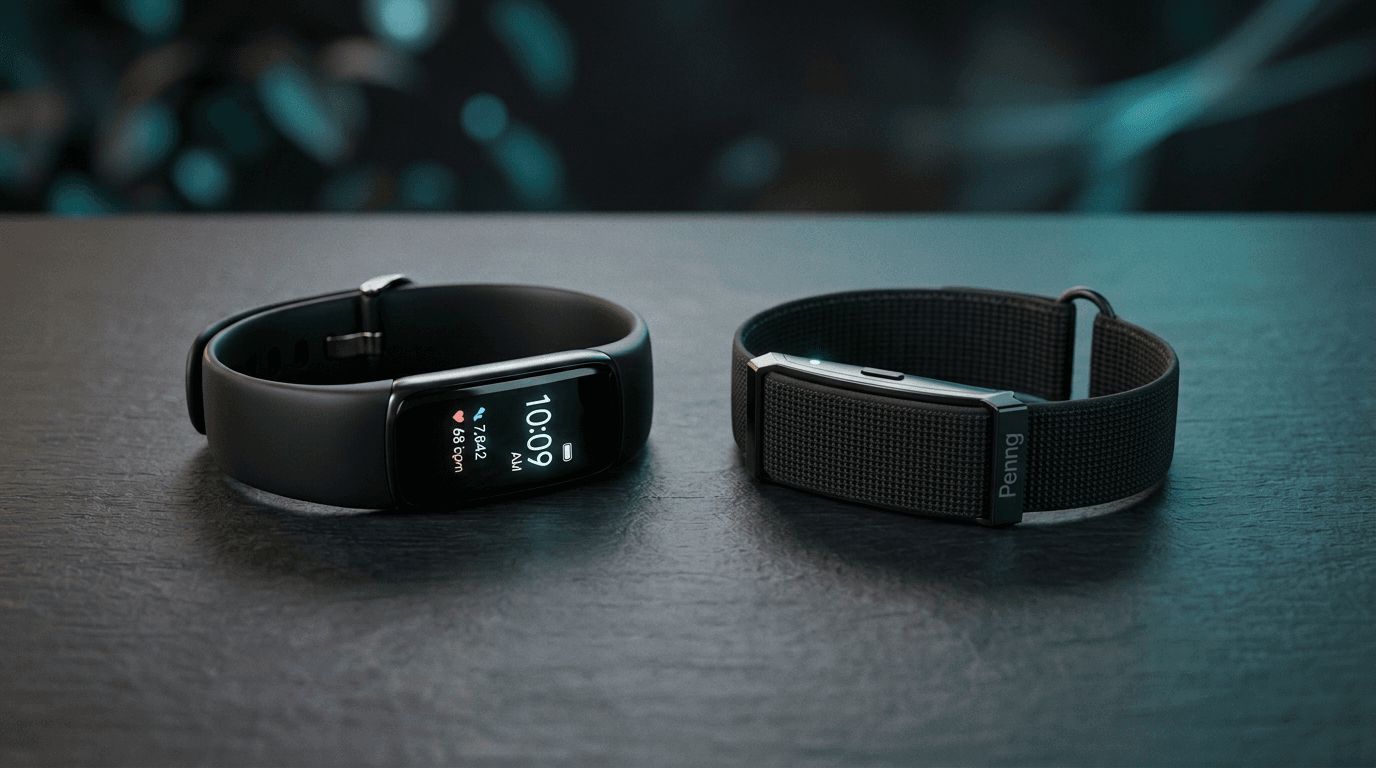
Fitbit has been in the health tracking game longer than almost anyone. They popularised step counting, made wrist-based heart rate monitoring mainstream, and built one of the largest health data ecosystems in the world. Then Google bought them. And things got complicated.
Penng is a newcomer from Cape Town, South Africa, with a different approach: screen-free tracking focused on recovery, strain, sleep, and AI-powered food logging. No step counting obsession. No social media-style badges. Just data that helps you make better decisions about training and nutrition.
This comparison looks at what each does well, where each falls short, and which one actually delivers more for your health in 2026.
Fitbit in 2026: The Google Factor
Before comparing features, it's worth understanding where Fitbit stands today. Google acquired Fitbit in 2021 and has been slowly merging Fitbit into the Google ecosystem. The Fitbit app has been absorbed into Google's health platform, and there's been a noticeable shift in focus.
The current Fitbit lineup is smaller than it used to be. The Fitbit Charge 6 is the standout fitness band, the Fitbit Sense 2 is the health-focused smartwatch, and the Versa 4 is the general-purpose smartwatch. Google has also released the Pixel Watch line, which essentially replaces the high end of Fitbit's range.
The result is some uncertainty about Fitbit's future as a standalone brand. The products are still good. But the ecosystem is in transition, and some features that used to be free now require Fitbit Premium (approximately R1,500/year).
Daily Readiness Score vs Recovery Score
Fitbit's Daily Readiness Score considers your recent sleep, HRV, and activity patterns to generate a score indicating whether you should push hard or recover. It's a solid metric that gives useful guidance.
The catch: The Daily Readiness Score requires Fitbit Premium. Without the subscription, you don't get this feature. At approximately R1,500/year, Premium unlocks readiness, detailed sleep analysis, wellness reports, mindfulness sessions, and workout videos.
Penng's Recovery Score runs 0-100% with a traffic-light colour system (green, yellow, red). It's calculated from overnight HRV, resting heart rate, sleep quality, and SpO2. The score is included with your Penng membership. There's no tiered access. Every feature is available to every user.
Beyond the readiness/recovery metric itself, Penng also generates a daily Strain Score (0-100) that tracks your accumulated exertion. Fitbit doesn't have an equivalent strain metric. It tracks Activity Zone Minutes (time spent in fat burn, cardio, and peak heart rate zones), which is useful but measures something different. Activity Zone Minutes tell you how much time you spent exercising. A strain score tells you the total physiological cost of your day.
Verdict: Both readiness metrics are useful. But Penng includes its recovery score with no additional subscription, pairs it with a strain score that Fitbit lacks, and uses a colour system that makes interpretation immediate.
Sleep Tracking
Fitbit's sleep tracking has been solid for years. It tracks sleep stages (Light, Deep, REM), time asleep, sleep schedule consistency, restlessness, and provides a Sleep Score. With Premium, you also get detailed sleep insights and trends.
Penng tracks sleep stages (Light, Deep, REM), overnight HRV, resting heart rate, SpO2, and generates a sleep score from 0 to 100. Both devices give you a clear picture of your night.
Fitbit's advantage is maturity. They've been refining sleep algorithms for nearly a decade, and their sleep data is backed by a massive dataset. Fitbit also offers smart wake alarms (vibrating the band during a light sleep phase near your alarm time), which Penng doesn't have.
Penng's advantage is that sleep data feeds directly into your morning recovery score, creating a clear chain: sleep quality affects recovery, recovery guides training intensity, training intensity affects tomorrow's sleep. It's a more integrated framework.
Verdict: Fitbit has more mature sleep features including smart wake alarms. Penng integrates sleep data more tightly into a recovery-strain framework.
Food Tracking
Fitbit has a built-in food logging feature in the app. You can search a database, scan barcodes (on your phone, not the tracker), and manually enter meals. It tracks calories, carbs, fat, protein, sodium, fibre, and water intake. The database is decent.
However, Fitbit's food tracking is purely manual. You search for "grilled chicken breast," select a portion size, and add it to your log. It's the same process that every food tracking app has used for the past fifteen years. And it's the same process that makes most people quit food tracking within the first two weeks because it's tedious.
Penng's food tracking takes a fundamentally different approach with AI-powered input across five methods:
- Photo - Snap your meal and Gemini Vision AI identifies food and estimates macros.
- Barcode scan - Scan packaged food for standardised nutrition from OpenFoodFacts.
- Text description - Type what you ate and AI parses macros automatically.
- Voice - Speak your meal description and speech-to-text handles the rest.
- Nutrition label photo - Photograph a nutrition label and AI reads the values directly.
The app tracks calories, protein, carbs, fat, fibre, sodium, sugars, and provides a health score and confidence level for each entry.
The practical difference is enormous. With Fitbit, logging a home-cooked meal means searching for each ingredient, estimating portions, and adding them individually. With Penng, you photograph the plate and the AI does the estimation. Is the AI perfect? No. But it reduces a five-minute process to about fifteen seconds, which is the difference between actually tracking your food consistently and abandoning the habit after a week.
Verdict: Penng wins significantly. AI food tracking with five input methods versus manual database searching is a generational difference in user experience.
Stress Management
Fitbit offers a stress management feature using an electrodermal activity (EDA) sensor on some models (Sense 2, primarily). It measures your body's stress response through skin conductance and provides a Stress Management Score. Fitbit also offers guided breathing and mindfulness sessions through Premium.
Penng doesn't have a dedicated stress metric or EDA sensor. However, HRV is fundamentally a stress indicator. Elevated stress depresses HRV, which shows up in your recovery score. So while Penng doesn't label it "stress management," the data that drives stress insights is present in the recovery framework.
Verdict: Fitbit has a more explicit stress management feature set, especially with the EDA sensor. Penng captures stress effects through HRV but doesn't package it as a standalone feature.
Hardware and Comfort
The Fitbit Charge 6 has a small OLED screen, weighs about 37g, and has a silicone band. It's slim, comfortable for 24/7 wear, and the screen is bright enough to read outdoors. It supports Google Wallet for payments and has built-in GPS.
Penng has no screen, weighs approximately 40g, and uses a zinc alloy case with a stretchy nylon strap. There's a simple LED indicator: green for Bluetooth connected, red for not connected. No payments. No GPS on the device (phone GPS is used for some workout types).
Both are comfortable for daily and nightly wear. The Fitbit Charge 6 has the advantage of a screen for quick glances at stats, time, and notifications. Penng has the advantage of a completely distraction-free experience.
Verdict: Personal preference. Fitbit is more versatile with its screen. Penng is more minimal and distraction-free.
Battery Life
Fitbit Charge 6 lasts approximately 7 days on a single charge. That's solid for a device with a screen and GPS.
Penng lasts approximately 21 days. Three times longer.
The Fitbit Sense 2 and Versa 4 last approximately 5-6 days, which is less than the Charge 6 because of larger screens and more features.
Longer battery life means fewer charging gaps in your data, less time remembering to charge, and more consistent 24/7 tracking.
Verdict: Penng wins clearly. 21 days versus 7 days is a meaningful practical advantage.
Water Resistance
Fitbit Charge 6 is rated to 50 metres (5 ATM). You can swim with it, shower with it, and not worry about water at all. Fitbit includes swim tracking as a workout type.
Penng is rated at 1 ATM, which means sweat, rain, and hand washing are fine. Swimming, showering, and water sports are not recommended.
If you swim regularly or want a tracker you never need to worry about around water, Fitbit handles this better.
Verdict: Fitbit wins. 5 ATM versus 1 ATM is a significant difference for anyone who's regularly around water.
Pricing
Fitbit Charge 6: approximately R3,500 once-off. No subscription required for basic features, but Fitbit Premium (approximately R1,500/year) is needed for Daily Readiness Score, detailed sleep analysis, wellness reports, and guided workouts.
Year 1 with Premium: approximately R5,000 Year 2 with Premium: approximately R1,500 Year 3 with Premium: approximately R1,500 Three-year total with Premium: approximately R8,000
Without Premium, three-year total: R3,500 (but you lose the readiness score and other key features).
Penng: R1,950/year all-in. Band included. Every feature included. No tiered access.
Year 1: R1,950 Year 2: R1,950 Year 3: R1,950 Three-year total: R5,850
If you're going to use Fitbit Premium (and you should, because the readiness score is arguably the most useful feature), Penng is cheaper over any time horizon beyond the first few months. If you're fine with basic Fitbit without Premium, the Charge 6 is cheaper long-term. Check our affordable fitness tracker guide for more price comparisons.
Verdict: Depends on whether you subscribe to Fitbit Premium. With Premium, Penng is cheaper. Without Premium, Fitbit's once-off cost is lower but you lose key features.
Head-to-Head Comparison Table
| Feature | Fitbit Charge 6 | Penng |
|---|---|---|
| Screen | Yes (OLED) | No (screen-free) |
| Battery | 7 days | 21 days |
| Recovery/Readiness | Daily Readiness (Premium only) | Recovery Score (included) |
| Strain tracking | Active Zone Minutes | Strain Score (0-100) |
| Sleep tracking | Yes (stages, score) | Yes (stages, HRV, SpO2) |
| Food tracking | Manual logging | AI-powered, 5 methods |
| Stress management | EDA sensor + score | HRV-based (via recovery) |
| Water resistance | 5 ATM (swim-proof) | 1 ATM (splash only) |
| GPS | Yes (built-in) | Phone GPS only |
| SpO2 | Yes | Yes |
| Workout detection | Auto + manual | Manual only |
| Payments | Google Wallet | No |
| Weight | ~37g | ~40g |
| Price | ~R3,500 + R1,500/yr Premium | R1,950/year (all-in) |
| SA local support | Limited (Google) | Yes (Cape Town) |
Who Should Buy Fitbit
- People who want a small screen on their wrist for quick stat checks
- Swimmers and water sports participants (5 ATM)
- Anyone who values the explicit stress management features with EDA sensor
- People who prefer a once-off purchase (without Premium)
- Casual fitness trackers who want step counting, basic sleep, and heart rate without a subscription
- Fans of the Google/Fitbit ecosystem
Who Should Buy Penng
- People who want recovery, strain, and food tracking integrated in one platform
- Anyone who finds traditional food logging tedious and wants AI to simplify it
- People who want all features included without a tiered subscription
- Users who value 21-day battery life for consistent data tracking
- South African buyers who want ZAR pricing and local Cape Town support
- Athletes who want a screen-free device that won't distract during training
The Bottom Line
Fitbit is a mature, well-rounded fitness tracker that does a lot of things competently. The Charge 6 is a good product at a reasonable price. But its most valuable health feature (the Daily Readiness Score) is locked behind a subscription, its food tracking is stuck in the manual-logging era, and its recovery insights don't go as deep as dedicated recovery-focused devices.
Penng is narrower in scope but deeper in its focus areas. The AI food tracking is genuinely better than anything Fitbit offers. The recovery-strain framework provides more actionable daily guidance. And the 21-day battery means you wear it more consistently, which means better data.
If you want a tracker that does a bit of everything with a screen and GPS, Fitbit is solid. If you want a tracker that goes deep on recovery and nutrition without the distractions, Penng is the better choice. For a broader comparison, see our best recovery tracker roundup for 2026.
Frequently Asked Questions
Do I need Fitbit Premium to use a Fitbit?
No, Fitbit works without Premium. You get basic step tracking, heart rate, sleep duration, and workout tracking. However, the Daily Readiness Score, detailed sleep stages analysis, wellness reports, and guided workouts require Premium at approximately R1,500/year. Penng includes all features with its R1,950/year subscription.
Is Fitbit's food tracking as good as Penng's?
Fitbit offers manual food logging through a searchable database. It works but requires you to search for each food item and estimate portions manually. Penng uses AI-powered food tracking with five input methods including photographing your meal, which reduces logging time from minutes to seconds and significantly improves consistency.
Which has better sleep tracking: Fitbit or Penng?
Both offer sleep stage tracking (Light, Deep, REM) and a sleep score. Fitbit has been refining its sleep algorithms for longer and offers additional features like smart wake alarms. Penng integrates sleep data more directly into a recovery framework. For most users, both provide sufficiently detailed sleep insights.
Can I swim with a Fitbit Charge 6?
Yes. The Fitbit Charge 6 is rated to 5 ATM (50 metres) and includes swim tracking as a workout type. Penng is rated at 1 ATM and is not recommended for swimming. If you swim regularly, Fitbit handles water significantly better.
Is Penng better value than Fitbit with Premium?
Over three years, Penng costs R5,850 (R1,950/year). Fitbit Charge 6 with Premium costs approximately R8,000 (R3,500 device + R1,500/year x 3). Penng includes all features in its subscription with no tiered access. However, if you skip Fitbit Premium, the Charge 6 alone at R3,500 is cheaper than even two years of Penng, though you lose the readiness score.
Not sure which health metrics matter most for your goals? Take the free quiz at penng.ai/quiz to find out what your body data is telling you.