Most fitness tracker reviews are written for runners. Distance, pace, GPS, VO2 max. That's great if you run. But if you spend most of your training time in a gym, lifting weights, doing circuits, or grinding through CrossFit workouts, those features are largely irrelevant.
What gym-goers actually need from a tracker is different. And most wearables don't deliver it particularly well.
This guide looks at what matters for gym-based training, which trackers handle it best, and what to ignore in marketing materials that are clearly written for endurance athletes.
What Gym-Goers Actually Need From a Tracker
Before comparing products, let's define what actually matters when you train in a gym.
1. Recovery Data
This is the most valuable metric for gym progress. Progressive overload, the fundamental principle of strength training, only works if you're actually recovered enough to push harder than last time. Train on an under-recovered day and you either stall or regress.
A tracker that tells you your recovery status every morning helps you make better decisions. Push hard on green days. Go moderate or deload on red days. Over weeks and months, this leads to more productive training sessions and fewer plateaus.
2. Heart Rate During Training
Heart rate during strength training is genuinely useful. It tells you your actual exertion level, helps you manage rest periods (waiting until your heart rate drops to a certain zone before your next set), and contributes to calorie burn estimates.
Heart rate zones during circuit training, HIIT, and CrossFit-style workouts are especially informative. You can see whether you're actually hitting the intensity you think you are.
3. Strain or Exertion Quantification
How hard was today's session relative to your capacity? This is different from tracking reps and sets. It's about the systemic cost of your training. A heavy squat day takes more from your body than a light arm workout, even if both take an hour. A tracker that quantifies total daily strain helps you balance training volume across the week.
4. Sleep Tracking
Sleep is when your muscles actually repair and grow. Tracking sleep quality, duration, and stages isn't a nice-to-have for serious lifters. It's directly connected to your recovery capacity. Poor sleep tonight means poor recovery tomorrow, which means a subpar training session the day after.
5. Nutrition Tracking
You can train perfectly and still make no progress if your nutrition doesn't support your goals. Whether you're trying to build muscle (caloric surplus, adequate protein) or cut fat (caloric deficit, maintained protein), tracking what you eat matters enormously for gym results.
What You Don't Need
- GPS: Unless you're running to the gym, GPS doesn't help your bench press.
- Automatic rep counting: Some trackers claim to count reps via accelerometer. In practice, accuracy is poor for most exercises beyond basic bicep curls. Don't buy a tracker for this feature.
- Notifications: Your rest periods are for rest, not reading emails.
The Problem With Smartwatches in the Gym
Here's something nobody talks about in most reviews: smartwatches are annoying in the gym.
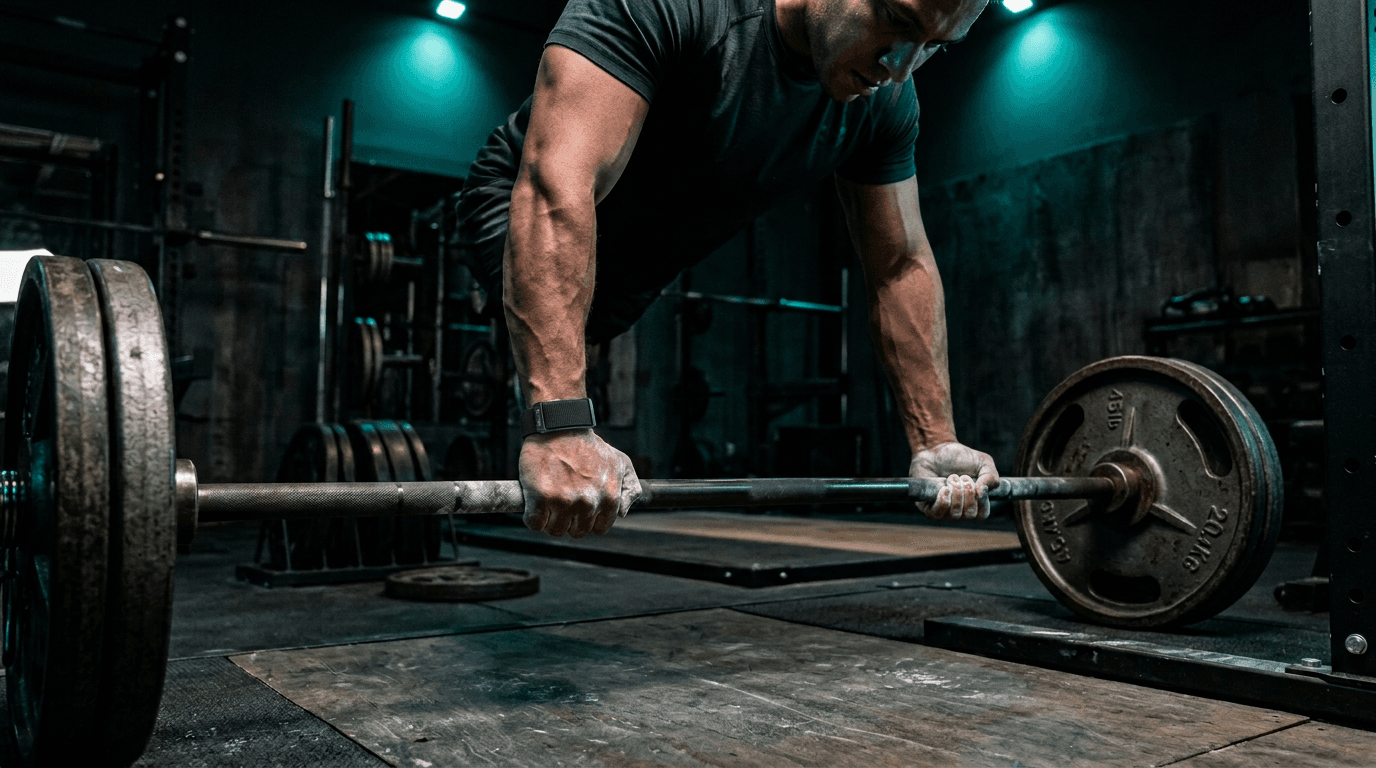
A big watch face gets in the way during barbell exercises. It presses into your wrist during front squats. It catches on cables during tricep pushdowns. The screen gets scratched by knurling on barbells. And every notification that pops up mid-set is a distraction that breaks your focus.
Gym-goers who've worn bulky smartwatches during lifting sessions know this. You end up taking the watch off for certain exercises, which defeats the purpose of continuous heart rate tracking.
Screen-free bands and slim trackers solve this problem by being smaller, lighter, and less obtrusive. There's nothing to catch on equipment, no screen to crack, and no notifications to distract you.
The Best Gym Trackers Compared
WHOOP 4.0
WHOOP is the gold standard for recovery tracking and has a strong following among CrossFit athletes and gym-goers.
Gym-relevant strengths:
- Excellent recovery score for daily training decisions
- Strain coach that adjusts targets based on your recovery
- Automatic workout detection
- Small, slim form factor that doesn't interfere with lifting
- Screen-free design (no distractions)
- Journal feature to correlate behaviours with recovery
Gym-relevant weaknesses:
- No food tracking (you need a separate app for nutrition)
- Battery lasts about 5 days
- Expensive at approximately R4,800/year
- No manual workout type selection beyond automatic detection
Best for: Serious athletes who want the deepest recovery analytics and don't mind paying premium pricing.
Apple Watch Series 10
The most popular smartwatch in the world, with good workout tracking capabilities.
Gym-relevant strengths:
- Accurate heart rate tracking
- Workout app with many exercise types
- Third-party apps like Strong for set/rep logging
- High and low heart rate alerts
Gym-relevant weaknesses:
- The watch face gets in the way during lifting
- Screen scratches easily on barbells and dumbbells
- 18-36 hour battery means charging daily
- No built-in recovery score (need third-party apps)
- Notifications constantly interrupting focus
- No food tracking built in
Best for: People who want a smartwatch first and gym tracker second.
Garmin Venu 3
Garmin's health-focused smartwatch with Body Battery and gym-specific features.
Gym-relevant strengths:
- Body Battery as a daily energy/recovery indicator
- Strength training workout profile with auto-rep counting
- Good heart rate monitoring
- Around 5 days of battery life
- Training readiness feature
Gym-relevant weaknesses:
- Bulky for barbell work
- Rep counting accuracy is inconsistent across exercises
- Food tracking is basic (MyFitnessPal sync)
- Screen can distract during training
Best for: People who want a mid-range smartwatch with reasonable gym features and don't mind wearing a larger device during lifting.
Fitbit Charge 6
A slim fitness band with a small screen and Google integration.
Gym-relevant strengths:
- Slim form factor that stays out of the way
- Exercise recognition with heart rate zones
- Google Wallet for post-gym purchases
- Daily Readiness Score (requires Premium)
- Approximately 7 days battery
Gym-relevant weaknesses:
- Readiness Score locked behind R1,500/year Premium subscription
- No strain tracking
- Food tracking is manual and basic
- Limited gym workout types compared to dedicated platforms
Best for: Casual gym-goers who want a simple tracker that isn't bulky.
Penng
Full disclosure: this is our product. We'll be honest about it.
Penng is a screen-free health band focused on recovery, strain, sleep, and AI food tracking.
Gym-relevant strengths:
- Recovery score (0-100%) with traffic-light system for immediate training decisions
- Strain score (0-100) that quantifies total daily exertion
- AI food tracking with five input methods (photo, barcode, text, voice, nutrition label)
- Screen-free design at 40g: nothing to catch on equipment, no screen to scratch
- 21-day battery: charge it twice a month, track continuously
- 109+ workout types including strength training, CrossFit, circuit training, yoga, and more
- Recovery-strain framework designed specifically for training load management
Gym-relevant weaknesses:
- Workouts must be manually started and ended in the app (no auto-detect)
- No rep counting or set tracking
- 1 ATM water resistance (no swimming, but fine for gym sweat)
- No on-wrist display for heart rate zones during workouts
- App is newer and less mature than WHOOP or Garmin
Best for: Gym-goers who want recovery, strain, and nutrition tracking integrated in one platform, without the distractions or bulk of a smartwatch.
Why Recovery Data Changes Gym Results
Most gym-goers track their workouts but not their recovery. They know what they did in the gym. They have no idea whether their body was ready for it.
This matters because progressive overload, the principle of gradually increasing training demands, assumes adequate recovery between sessions. If you're training heavy squats on a day when your body is still recovering from Monday's session, you're not getting the stimulus you think you are. You're accumulating fatigue without proportional adaptation.
A recovery score answers a simple question every morning: "Should I push hard today, go moderate, or back off?" Over weeks, this leads to better session quality, fewer unnecessary deload weeks, and more consistent progress.
For a deeper look at this, read our guide on signs of overtraining and how to track recovery.
Why Food Tracking Matters for Gym Goals
You've heard the cliche: you can't out-train a bad diet. It's a cliche because it's true.
For muscle building, you need a caloric surplus and adequate protein (generally 1.6-2.2g per kg of body weight). For fat loss, you need a caloric deficit while maintaining protein to preserve muscle mass. For body recomposition, you need precise nutrition management.
The problem is that most people dramatically underestimate their calorie intake and overestimate their protein consumption. Without tracking, you're guessing. And the research on self-reporting food intake is clear: people are consistently wrong.
A tracker that includes food logging makes the data loop complete: recovery tells you when to train, strain tells you how hard you trained, and nutrition tells you whether you're fuelling your goals. Most gym trackers require separate nutrition apps. The few that include food tracking still use manual database logging that most people abandon quickly.
Penng's AI food tracking reduces the friction significantly. Snap a photo of your post-workout meal instead of searching for "chicken breast 200g, sweet potato 150g, broccoli 100g" in a database. Whether the AI is perfectly accurate for every meal is less important than whether you actually log consistently. For more on this approach, see our best screen-free fitness trackers comparison.
The Screen-Free Advantage in the Gym
This isn't just a philosophical preference. There are practical reasons why screen-free trackers work better during gym sessions:
No interference with movements. A big watch face presses into your wrist during front rack positions, overhead presses, push-ups, and any exercise where your wrist flexes. A slim band with no screen sits flat and stays out of the way.
No screen to damage. Barbells, dumbbells, cable attachments, and gym equipment are not gentle on watch faces. Scratched screens are common among gym-goers who wear smartwatches during lifting. No screen means nothing to scratch.
No distractions. Every notification that lights up your wrist during a set breaks your concentration. In exercises like heavy squats or deadlifts, focus is a safety issue, not just a performance one. Screen-free means your wrist never lights up.
Consistent heart rate tracking. Because you never take off a slim screen-free band mid-workout (unlike a bulky watch that gets uncomfortable during certain exercises), your heart rate data is continuous through the entire session.
Gym-Specific Comparison Table
| Feature | WHOOP | Apple Watch | Garmin Venu 3 | Fitbit Charge 6 | Penng |
|---|---|---|---|---|---|
| Recovery score | Yes | No (need 3rd party) | Body Battery | Premium only | Yes (0-100%) |
| Strain metric | Yes (0-21) | No | Training Load | No | Yes (0-100) |
| Food tracking | No | No | Basic sync | Manual | AI (5 methods) |
| Battery | ~5 days | 18-36 hrs | ~5 days | ~7 days | 21 days |
| Screen-free | Yes | No | No | No | Yes |
| Weight | ~27g | ~36-52g | ~35g | ~37g | ~40g |
| Gym comfort | Excellent | Poor (bulky) | Moderate | Good | Excellent |
| Workout types | Auto-detect | Many | Many w/ rep count | Limited | 109+ (manual) |
| Annual cost | ~R4,800/yr | ~R8,000+ once | ~R7,500 once | ~R3,500 + R1,500/yr | R1,950/yr |
The Best Gym Tracker by Priority
If recovery is your top priority: WHOOP has the most mature recovery algorithm and strain coaching. Penng offers a comparable recovery-strain framework at less than half the annual cost.
If food tracking matters: Penng is the only option with built-in AI food tracking. Everything else requires a separate app.
If you want a screen during workouts: Garmin Venu 3 offers the best gym-specific smartwatch experience with rep counting and heart rate zones visible on-wrist.
If budget is the primary concern: Penng at R1,950/year is the most affordable option that includes both recovery and food tracking. Fitbit Charge 6 is cheaper upfront but locks key features behind Premium.
If you want the least intrusive gym experience: WHOOP and Penng are both screen-free and slim enough to stay out of the way during any exercise. Penng's 21-day battery means you charge it less often.
For a deeper look at recovery-focused wearables specifically, see our best recovery tracker 2026 comparison.
The Bottom Line
The best gym tracker isn't the one with the most features. It's the one that gives you the data that actually improves your results: recovery status, daily strain, sleep quality, and nutrition.
Most smartwatches are built for runners and general fitness. They have GPS, turn-by-turn navigation, and pace alerts that mean nothing when you're under a barbell. What they often lack is a clear recovery-strain framework and integrated food tracking.
If you train in a gym more than you train on roads or trails, think carefully about what data actually moves the needle for your goals. Recovery timing, training load management, and nutrition consistency matter far more than step counts and GPS accuracy.
Frequently Asked Questions
Do I need a fitness tracker for the gym?
A fitness tracker isn't essential for gym training, but recovery data can meaningfully improve your results. Knowing whether your body is recovered before a heavy session helps you time your hard workouts for maximum benefit and avoid training on depleted days. The combination of recovery, strain, and nutrition tracking creates a complete feedback loop that manual tracking can't match.
Can fitness trackers count reps accurately?
Some trackers (notably Garmin) offer rep counting using accelerometer data. In practice, accuracy varies significantly by exercise. Simple, repetitive movements like bicep curls are tracked reasonably well. Complex movements like Olympic lifts, cable exercises, or machine-based exercises are poorly tracked or misidentified. Don't buy a tracker specifically for rep counting.
Why is a screen-free tracker better for the gym?
Screen-free trackers are slimmer, lighter, and don't interfere with barbell exercises or wrist-flexion movements. There's no screen to scratch on equipment and no notifications to break your focus mid-set. For heavy compound lifts where concentration is a safety concern, the absence of wrist notifications is a genuine advantage.
How does recovery tracking help with progressive overload?
Progressive overload requires you to gradually increase training demands over time. This only works if you're recovered enough to handle the increased load. A recovery score tells you which days to push harder and which days to moderate intensity. Over weeks, this leads to more productive training sessions and more consistent strength gains compared to following a rigid programme regardless of recovery state.
What should I look for in a gym fitness tracker?
Prioritise recovery data (a daily score based on HRV, sleep, and heart rate), strain or exertion tracking, sleep quality monitoring, comfortable form factor that doesn't interfere with lifting, and ideally food tracking. GPS, navigation, and advanced running metrics are unnecessary for gym-based training. Battery life matters too: a tracker you have to charge daily creates data gaps that reduce the value of trend analysis.
Want to know if your gym training is balanced with your recovery? Take the free quiz at penng.ai/quiz to find out how your body is handling your training load.