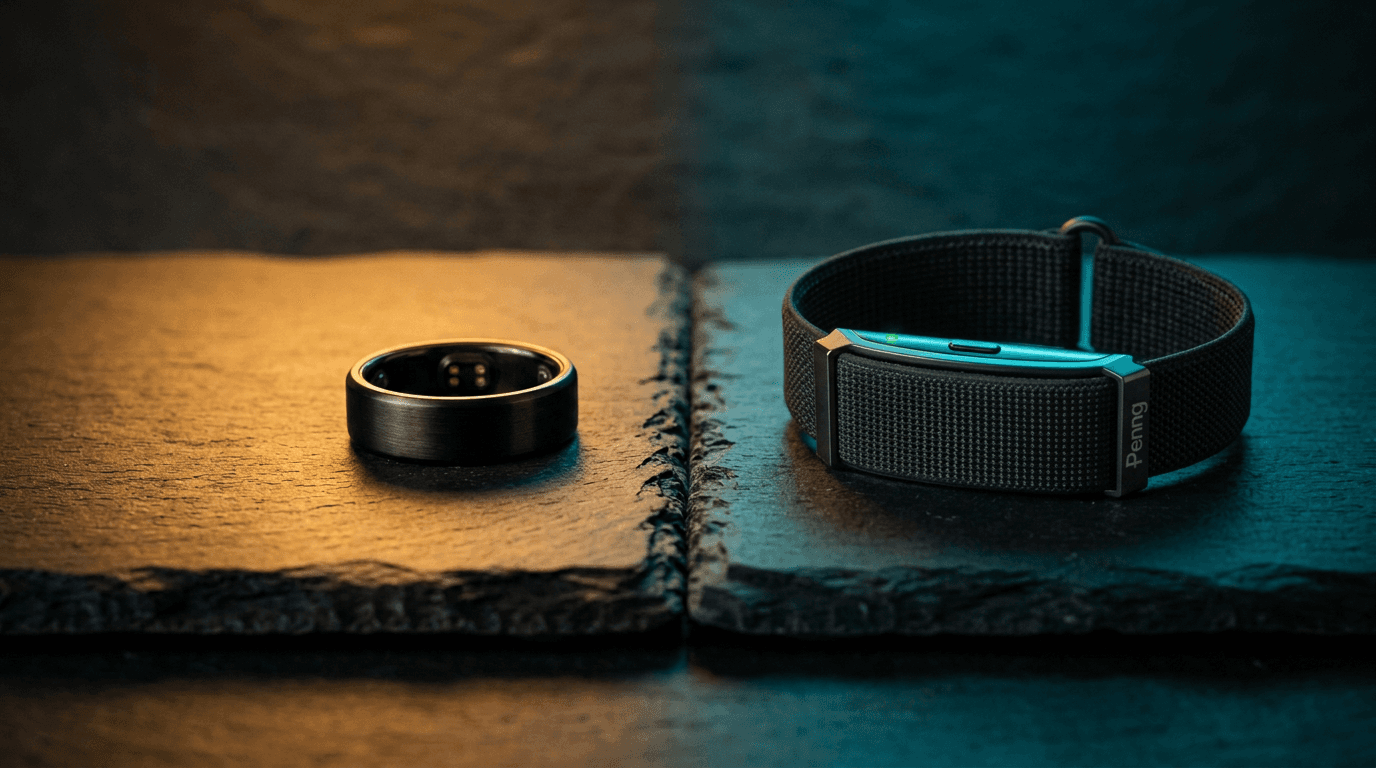
The Oura Ring and Penng represent two very different philosophies in screen-free health tracking. One sits on your finger. The other wraps around your wrist. Both promise to help you understand your body through data rather than distractions.
But underneath the form factor differences, these are fundamentally different products built for different people. This comparison breaks down what each does well, where each falls short, and who should buy which.
Form Factor: Ring vs Band
This is the most visible difference, so let's start here.
The Oura Ring Gen 4 is a titanium ring weighing roughly 4-6g depending on size. You wear it like jewellery. Most people forget it's a health tracker. It's discreet, looks good in professional settings, and doesn't scream "I track my biometrics."
Penng is a screen-free wristband weighing approximately 40g with a zinc alloy case and stretchy nylon strap. There's no display, just a simple LED indicator (green for connected, red for not). It's light enough that most people forget they're wearing it within a few days.
Where Oura wins: Discretion. If you don't want anyone to know you're wearing a tracker, a ring beats a wristband every time. It's also arguably more comfortable during sleep for people who don't like anything on their wrist at night.
Where Penng wins: Wrist-based optical heart rate tends to be more accurate during exercise than finger-based readings, particularly during high-intensity or high-motion activities. The wrist also has more surface area for sensors.
Neither has a screen, which means neither buzzes your wrist with notifications, emails, or social media alerts. Both keep the data in the app where it belongs.
Sleep Tracking
Let's be direct about this: Oura's sleep tracking is the best in any consumer wearable. It's what Oura is known for, and they've earned that reputation over years of refinement.
Oura tracks sleep stages (Light, Deep, REM), sleep latency, time in bed, restfulness, heart rate during sleep, HRV trends, and blood oxygen. Their sleep score algorithm has been validated in multiple studies, and the finger is actually an excellent location for overnight biometrics because the arteries are close to the surface and there's minimal motion artefact when you're lying still.
Penng also tracks sleep stages (Light, Deep, REM), HRV overnight, resting heart rate, SpO2, and generates a sleep score from 0 to 100. The data is solid and gives you a clear picture of your night. But Oura has a significant head start in this department. Their algorithms have been refined over multiple hardware generations, and their sleep insights go deeper.
Oura also tracks skin temperature trends, which can flag early signs of illness or hormonal shifts. Penng does not have a skin temperature sensor.
Verdict: Oura wins on sleep. If sleep optimisation is your primary goal, Oura is the better product for that specific use case.
Recovery and Readiness
Both devices generate a daily score that tells you how recovered your body is.
Oura's Readiness Score considers your sleep quality, HRV trends, resting heart rate, body temperature, and previous day's activity. It's a well-rounded metric that's been refined over years. The score gives you a good sense of whether to push hard or take it easy.
Penng's Recovery Score runs 0-100% with a traffic-light colour system (green, yellow, red) that makes interpretation immediate. It's based on HRV, resting heart rate, sleep quality, and SpO2. Green means you're recovered and ready. Yellow means moderate. Red means rest or go easy.
Both approaches work well. Oura's readiness score has more historical data to draw from given the company's longer track record. Penng's traffic-light system is more immediately actionable, especially for people who don't want to interpret numbers.
Verdict: Roughly comparable. Oura has more maturity in its algorithm. Penng has simpler, faster interpretation.
Strain and Activity Tracking
Here's where the products diverge significantly.
Oura is primarily a recovery and sleep tracker. It logs daily activity (steps, calories, movement), and the Gen 4 added improved workout heart rate tracking. But Oura doesn't generate a true strain or exertion score. It tells you to hit a daily activity goal, but it doesn't quantify the physiological cost of your workouts the way a strain-focused device does.
Penng tracks strain on a 0-100 scale throughout the day. Every workout, every walk, every stressful meeting contributes to your strain score. The relationship between your recovery score and your accumulated strain tells you whether you're pushing at the right intensity for your current state.
Penng supports 109+ workout types that are manually started and ended in the app. This includes everything from strength training to cycling to yoga to basketball. Important note: Penng does not auto-detect workouts. You need to start and stop them yourself through the app.
Verdict: Penng wins on strain tracking. If you want to quantify daily exertion and balance it against recovery, Penng gives you that data. Oura doesn't really try to.
Food Tracking
This is Penng's biggest differentiator, and not just against Oura. Against every wearable.
Oura has no food tracking capability. Zero. If you want to log nutrition with Oura, you need a separate app entirely.
Penng has AI-powered food tracking built directly into the app with five input methods:
- Photo - Snap a picture of your meal and Gemini Vision AI identifies the food and estimates macros.
- Barcode scan - Scan packaged food for standardised nutrition data from OpenFoodFacts.
- Text description - Type what you ate in natural language and AI parses the macros.
- Voice - Tap the microphone, describe your meal, and speech-to-text feeds the AI parser.
- Nutrition label photo - Photograph a nutrition label and AI extracts the values directly.
The app tracks calories, protein, carbs, fat, fibre, sodium, sugars, and gives each meal a health score. For people who care about both recovery and nutrition, having it all in one app matters. You don't lose context switching between three different platforms. For more on how this works in practice, see our guide on how to track calories without the tedious logging.
Verdict: Penng wins decisively. Oura has nothing comparable.
Battery Life
Oura Ring Gen 4 lasts approximately 5-7 days on a single charge. That's decent for a ring-sized device. Most people charge it while they shower in the morning.
Penng lasts approximately 21 days on a single charge. You charge it roughly twice a month with a magnetic charger that takes a few hours from flat to full.
The battery difference matters more than people think. Every time you take a device off to charge, you create a gap in your data. With Oura, you're creating those gaps every 5-7 days. With Penng, you're creating them roughly once every three weeks. For continuous health tracking, fewer gaps mean better trend data.
Verdict: Penng wins clearly. 21 days versus 5-7 days is a significant practical difference.
Water Resistance
Here's where Oura wins without contest.
The Oura Ring Gen 4 is rated to 100 metres. You can swim with it, shower with it, and generally not worry about water at all.
Penng is rated at 1 ATM, which means it's safe for sweat, rain, and hand washing. It is not recommended for swimming, showering, or surfing. If you submerge it, you're likely going to damage it.
If you swim regularly, if you surf, if you're in the water often, Oura is the clearly better choice for water resistance. This isn't a marginal difference. It's a fundamental limitation of Penng that you should know about before buying.
Verdict: Oura wins, and it's not close. If water activities matter to you, this could be a dealbreaker for Penng.
Pricing
Oura Ring Gen 4 costs approximately R6,000 upfront for the ring, plus around R100/month (roughly R1,200/year) for the Oura Membership subscription that unlocks full features. Without the membership, you get severely limited functionality. So your first-year cost is approximately R7,200, and subsequent years run R1,200 each.
Penng costs R1,950/year. That includes the physical band and a full year of membership. Everything is included. There's no tiered features locked behind different subscription levels. When you renew, you pay for the membership only.
Over three years, Oura costs you approximately R9,600 (R6,000 ring + R3,600 in subscriptions). Penng costs R5,850 (R1,950 x 3 years).
Important context: Oura is priced in USD, and it lists South Africa as a retailer-only market, meaning it does not ship here from its own store. In practice most South Africans import through third-party retailers at a markup, with the USD membership on top. Penng is priced in ZAR with free shipping within South Africa.
For a broader view of recovery-focused wearable pricing, check our best recovery tracker 2026 comparison, or see the quick side-by-side on our Penng vs Oura comparison page.
Verdict: Penng is significantly more affordable, especially for South African buyers.
Head-to-Head Comparison Table
| Feature | Oura Ring Gen 4 | Penng |
|---|---|---|
| Form factor | Titanium ring (~4-6g) | Screen-free band (~40g) |
| Battery | 5-7 days | 21 days |
| Sleep tracking | Best in class | Good (stages, HRV, SpO2) |
| Recovery score | Yes (Readiness) | Yes (0-100%, traffic light) |
| Strain tracking | Basic activity goals | Yes (0-100 scale) |
| Food tracking | No | AI-powered, 5 methods |
| Skin temperature | Yes | No |
| Respiratory rate | Yes | No |
| SpO2 | Yes | Yes |
| Water resistance | 100m | 1 ATM (splash only) |
| Workout types | Limited | 109+ |
| First-year cost | ~R7,200 | R1,950 |
| Annual renewal | ~R1,200 | R1,950 |
| SA local support | No | Yes (Cape Town) |
| Pricing currency | USD | ZAR |
Who Should Buy the Oura Ring
- People who prioritise sleep tracking above all other metrics
- Anyone who wants a completely discreet tracker that looks like jewellery
- Swimmers and water sports enthusiasts
- People who want skin temperature tracking for illness detection or cycle tracking
- Those who prefer a ring form factor over a wristband
Who Should Buy Penng
- People who want recovery data AND food tracking in one device
- Anyone who values long battery life (21 days vs charging every week)
- People who want strain tracking to balance daily exertion against recovery
- South African buyers who want ZAR pricing and local support
- Athletes who want manual workout tracking across 109+ activity types
- Budget-conscious buyers who want comprehensive health data without spending R7,000+ upfront
The Bottom Line
These products serve different primary needs. Oura is the best sleep tracker on the market with a beautiful, discreet form factor and excellent water resistance. If sleep is your primary concern and you don't care about food tracking or strain quantification, Oura is hard to beat.
Penng is the better choice if you want a complete health picture that includes recovery, strain, sleep, AND nutrition in a single ecosystem. The 21-day battery, AI food tracking, and ZAR pricing make it a different kind of value proposition. But you need to accept the limitations: no swimming, no skin temperature, and a newer app with less maturity than Oura's.
Neither product is objectively better. They're built for different people with different priorities. For a wider comparison of screen-free options, see our best screen-free fitness trackers in 2026 roundup, or for a look at how Penng compares to WHOOP, read our WHOOP vs Penng comparison.
Frequently Asked Questions
Is the Oura Ring better than a wristband for health tracking?
It depends on what you're tracking. The Oura Ring is excellent for sleep and recovery metrics because the finger provides clean biometric readings at rest. However, wrist-based trackers like Penng generally offer better accuracy during active exercise and can house more sensors. Neither form factor is universally superior.
Can I track food with the Oura Ring?
No. The Oura Ring has no food tracking capability. If you want to log nutrition alongside your Oura data, you'll need a separate app like MyFitnessPal or Cronometer. Penng is the only screen-free tracker with built-in AI food tracking across five input methods including photo, barcode, text, voice, and nutrition label scanning.
How does Oura's readiness score compare to Penng's recovery score?
Both use HRV, resting heart rate, and sleep quality to generate a daily score indicating how recovered your body is. Oura additionally factors in skin temperature trends. Penng uses a traffic-light colour system (green/yellow/red) for immediate interpretation. Both are effective at guiding daily training intensity decisions.
Is Penng waterproof enough for daily use?
Penng is rated at 1 ATM, which means it handles sweat, rain, and hand washing without issues. It is not recommended for swimming, showering, or water sports. If you regularly swim or surf, Oura's 100-metre water resistance is the better choice for your lifestyle.
Which is more affordable: Oura Ring or Penng?
Penng costs R1,950/year including the band and full membership. The Oura Ring Gen 4 costs approximately R6,000 upfront plus R1,200/year for the full membership subscription. Over three years, Penng costs R5,850 versus Oura's approximately R9,600. For South African buyers, Penng also avoids import duties and ships free in ZAR.
Curious which tracker fits your health goals? Take the free quiz at penng.ai/quiz to get a personalised recommendation in under two minutes.