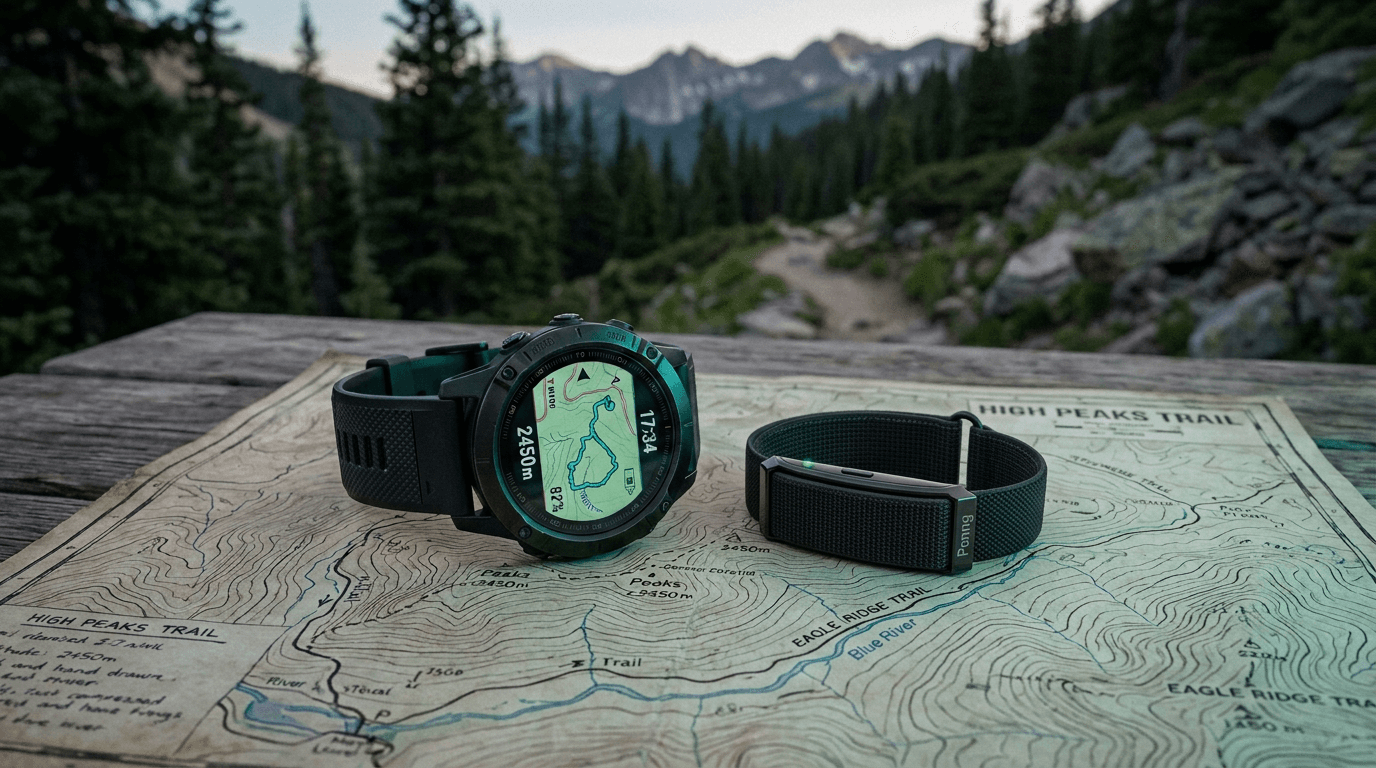
Garmin and Penng sit at opposite ends of the wearable philosophy spectrum. Garmin builds feature-rich smartwatches with screens, GPS, maps, music storage, and dozens of sport profiles. Penng builds a screen-free band that focuses entirely on health data: recovery, strain, sleep, and food tracking.
Comparing them directly feels a bit like comparing a Swiss Army knife to a scalpel. They're both useful. They're designed for fundamentally different things. But if you're choosing between them, this breakdown will help you pick the right one for how you actually live and train.
The Core Philosophy Difference
Garmin wants to be your everything device. Navigation during a trail run. Music on your long cycle. Notifications from your phone. Payment at the coffee shop afterwards. Training plans, weather, altimeter, compass. It's a computer on your wrist.
Penng wants to be invisible. No screen. No notifications. No distractions. It collects your biometric data continuously, you open the app when you want to see your numbers, and the rest of the time it just sits there silently doing its job.
These are legitimate, opposing design philosophies. Neither is wrong. But they attract different people.
If you want real-time data during a workout (your pace, your heart rate zone, your navigation), you need a screen. Garmin gives you that. If you want to stop looking at your wrist and let your data accumulate in the background, Penng gives you that.
For a deeper look at the screen-free philosophy, read our piece on why a screen-free fitness tracker might be exactly what you need.
Body Battery vs Recovery Score
Garmin's Body Battery is one of the more popular recovery-adjacent features in wearables. It runs on a 0-100 scale and estimates your energy reserves throughout the day based on HRV, stress, sleep, and activity. You can watch it drain during a hard workout and recharge during rest.
Penng's Recovery Score also runs 0-100% and uses a traffic-light colour system: green (recovered, push hard), yellow (moderate, be smart), red (depleted, rest or go easy). It's calculated from overnight HRV, resting heart rate, sleep quality, and SpO2.
There are meaningful differences in how these work:
Body Battery updates throughout the day. You can check it before, during, and after activities to see the impact in real time. This is useful if you're deciding mid-afternoon whether to do a hard evening session.
Penng's Recovery Score is a morning metric based on overnight data. It tells you how recovered you are when you wake up. It doesn't fluctuate throughout the day. The strain score (0-100) separately tracks your daily exertion and accumulates as you do more.
Body Battery is more dynamic. Penng's approach is more structured: one recovery number in the morning, one strain number that builds through the day. Different people prefer different approaches.
Verdict: Both are useful. Body Battery is more dynamic and responsive. Penng's approach is simpler and pairs recovery with a separate strain metric for a clearer push-vs-rest framework.
GPS and Outdoor Sports
Garmin dominates here. Full stop.
Garmin devices offer multi-band GPS, detailed mapping, breadcrumb navigation, route planning, ClimbPro for elevation management, weather integration, and sport-specific metrics for running, cycling, swimming, hiking, skiing, golf, and more. If you're a trail runner who needs turn-by-turn navigation, or a cyclist who wants real-time power data, or a hiker who needs topographic maps, Garmin is the industry standard.
Penng does not have built-in GPS. Some workout types support GPS at minimum for start and end location tracking, but this relies on your phone's GPS. There's no on-wrist navigation, no route planning, no maps.
For pure outdoor sports tracking, Garmin is in a different league. This isn't a close comparison. If GPS matters to you, Garmin wins.
Verdict: Garmin wins decisively for anyone who needs GPS, navigation, or detailed outdoor sport metrics.
Food Tracking
This is where the tables turn completely.
Garmin's food tracking is basic. Through the Garmin Connect app, you can log food manually or sync with MyFitnessPal. The integration works, but it's not native to the Garmin experience. You're essentially using a third-party food tracking app that happens to share data with your Garmin dashboard. The food logging itself is the same tedious manual process that makes most people give up within two weeks.
Penng's food tracking is AI-powered and built directly into the app with five input methods:
- Photo - Photograph your meal and Gemini Vision AI identifies the food and estimates macros.
- Barcode scan - Scan packaged food for standardised nutrition from OpenFoodFacts.
- Text description - Type what you ate in natural language and AI parses the macros.
- Voice - Speak what you ate and speech-to-text feeds the AI parser.
- Nutrition label photo - Photograph a nutrition label and AI extracts values directly.
The app tracks calories, protein, carbs, fat, fibre, sodium, sugars, and provides a health score for each meal. It's a fundamentally different experience from typing "chicken breast 150g" into a search bar. For more on this approach, see how to track calories without the tedious logging.
Verdict: Penng wins clearly. AI-powered food tracking with five input methods versus manual logging through a third-party sync is not a close comparison.
Battery Life
Garmin's battery life varies enormously by model:
- Garmin Venu 3: ~5 days in smartwatch mode
- Garmin Forerunner 265: ~13 days in smartwatch mode
- Garmin Fenix 8: ~20-28 days depending on variant
- Garmin Enduro 3: 60+ days in some modes
The solar-equipped models like the Enduro and some Fenix variants can last weeks or even months with limited feature use.
Penng lasts approximately 21 days on a single charge.
This comparison is model-dependent. A Garmin Venu 3 needs charging more often than Penng. A Garmin Fenix 8 is roughly comparable. A Garmin Enduro 3 outlasts everything on the market.
The key difference is that Garmin's battery life degrades significantly when you use GPS, music, or the always-on display. In full smartwatch mode with GPS tracking, many Garmin models last 5-10 days. Penng's 21 days is more predictable because there's no screen to drain the battery and no GPS to toggle on and off.
Verdict: Depends on the Garmin model. Penng's 21 days beats most mid-range Garmins in real-world use but not the ultra-endurance models like the Fenix 8 or Enduro 3.
Notifications and Connectivity
Garmin smartwatches mirror your phone notifications. Calls, texts, emails, app alerts, calendar reminders. Some models support music playback and contactless payments. You can reply to messages on certain models.
Penng has none of that. No notifications. No calls. No music. No payments. By design.
This is either a dealbreaker or the entire point, depending on your perspective. If you need to stay connected during the day and don't want to pull your phone out, Garmin's notification mirroring is genuinely useful. If you're trying to reduce screen time and digital distractions, Penng's deliberate absence of notifications is the feature.
Verdict: Garmin if you want connectivity. Penng if you want to escape it.
Workout Tracking
Garmin offers dozens of built-in sport profiles with detailed, sport-specific metrics. Running dynamics (cadence, ground contact time, vertical oscillation), cycling power, swimming metrics (SWOLF, stroke count), skiing runs, golf shot tracking. Many models auto-detect common activities.
Penng supports 109+ workout types that must be manually started and ended in the app. Heart rate data is tracked during workouts and contributes to your daily strain score. There's no auto-detect for workouts. You start them yourself.
Garmin's workout tracking is deeper and more sport-specific. If you want running dynamics or cycling power or swimming stroke analysis, Garmin provides that level of detail. Penng's workout tracking is built around the strain and recovery framework: how much did this cost your body, and how does that compare to your recovery capacity?
Verdict: Garmin wins on sport-specific depth. Penng wins on strain-recovery integration. Depends on what you want from workout data.
Pricing
Garmin's pricing ranges wildly:
- Garmin Venu Sq 2: ~R3,500
- Garmin Forerunner 265: ~R6,500
- Garmin Venu 3: ~R7,500
- Garmin Fenix 8: ~R15,000-R20,000+
- Garmin Enduro 3: ~R15,000+
No subscription required. You pay once for the hardware and get all features for the life of the device. Garmin Connect is free.
Penng costs R1,950/year. That includes the physical band and a full year of membership. If you stop paying, the band stops collecting new data (though past data remains viewable).
The pricing comparison depends on your time horizon. A Garmin Venu Sq 2 at R3,500 is cheaper than two years of Penng. A Garmin Fenix 8 at R15,000 is more expensive than seven years of Penng. But Garmin devices don't require ongoing payments, whereas Penng does.
For South African buyers, Garmin does have local retail presence, so you avoid import headaches. However, pricing is still effectively USD-pegged through local distributors. Penng is priced directly in ZAR. Check our best fitness tracker for South Africa guide for more context on local pricing.
Verdict: Garmin has no subscription, which is simpler. Penng has a lower entry point. Your total cost depends on how many years you use the device and which Garmin model you'd buy.
Head-to-Head Comparison Table
| Feature | Garmin (mid-range) | Penng |
|---|---|---|
| Screen | Yes (colour display) | No (screen-free) |
| GPS | Multi-band, on-device | Phone GPS only |
| Battery | 5-28 days (model-dependent) | 21 days |
| Recovery metric | Body Battery | Recovery Score (0-100%) |
| Strain tracking | Training Load/Status | Strain Score (0-100) |
| Food tracking | Basic (MyFitnessPal sync) | AI-powered, 5 methods |
| Sleep tracking | Yes | Yes (stages, HRV, SpO2) |
| Notifications | Yes | No |
| Workout detection | Auto + manual | Manual only |
| Water resistance | 5 ATM+ | 1 ATM |
| Weight | 40-80g (model-dependent) | 40g |
| Price | R3,500-R20,000+ (once-off) | R1,950/year |
| Subscription | None | Required |
| SA local support | Yes (distributors) | Yes (Cape Town) |
Who Should Buy Garmin
- Outdoor athletes who need GPS and navigation
- Runners, cyclists, and swimmers who want sport-specific metrics
- People who want notifications, music, and payments on their wrist
- Anyone who prefers a once-off purchase over a subscription
- Multi-sport athletes who need auto workout detection
- People who swim regularly (5 ATM+ water resistance)
Who Should Buy Penng
- People who want recovery and strain data paired with AI food tracking
- Anyone seeking fewer distractions and digital noise from their wearable
- People who want a simple daily framework: morning recovery, daily strain, nutrition balance
- South African buyers who want straightforward ZAR pricing
- Anyone who values 21-day battery life with predictable, consistent performance
- People who find traditional food logging tedious and want AI to handle it
The Bottom Line
Garmin is a better product for active sport tracking, outdoor navigation, and people who want their wearable to do everything. It's a mature ecosystem backed by decades of GPS technology. If you run trails, cycle long distances, or swim, Garmin's sport-specific features are unmatched.
Penng is a better product for people who care about the balance between recovery, exertion, and nutrition. The AI food tracking alone sets it apart from anything Garmin offers, and the screen-free design is a genuine advantage for people who are tired of another screen competing for their attention. The 21-day battery means you almost never think about charging.
For a wider view of how recovery trackers compare, see our best recovery tracker 2026 roundup.
Frequently Asked Questions
Is Garmin Body Battery the same as a recovery score?
Not exactly. Garmin's Body Battery is a dynamic energy estimate that fluctuates throughout the day, showing your current energy reserves in real time. Penng's Recovery Score is a morning metric based on overnight biometrics that tells you how recovered you are when you wake up. Both help guide training intensity, but they update differently and use slightly different inputs.
Does Garmin have food tracking?
Garmin Connect allows basic food logging and can sync with MyFitnessPal. However, the food tracking is manual and uses traditional search-and-select methods. Penng's AI food tracking lets you photograph meals, scan barcodes, use voice input, or type natural language descriptions, making the process significantly faster and more convenient.
Can Penng replace a Garmin for running?
For basic run tracking with heart rate and strain data, Penng works well. But if you need GPS pace, distance, route mapping, running dynamics, or training plans on your wrist, Garmin is the better tool. Penng does not have on-device GPS or a screen for real-time metrics during runs.
Which lasts longer on a single charge?
Penng lasts approximately 21 days consistently. Garmin's battery life varies from 5 days (Venu 3 with heavy use) to 60+ days (Enduro 3 with solar charging). Most mid-range Garmin models last 7-14 days in smartwatch mode, but GPS use drains the battery significantly faster.
Is Penng cheaper than Garmin?
Penng's entry cost (R1,950/year) is lower than most Garmin watches. However, Penng requires annual renewal while Garmin is a once-off purchase. Over 3-5 years, total cost depends on which Garmin model you're comparing. A budget Garmin may cost less over time; a premium Garmin will cost significantly more.
Want to find out which health metrics matter most for your goals? Take the free quiz at penng.ai/quiz to get a personalised recommendation in two minutes.