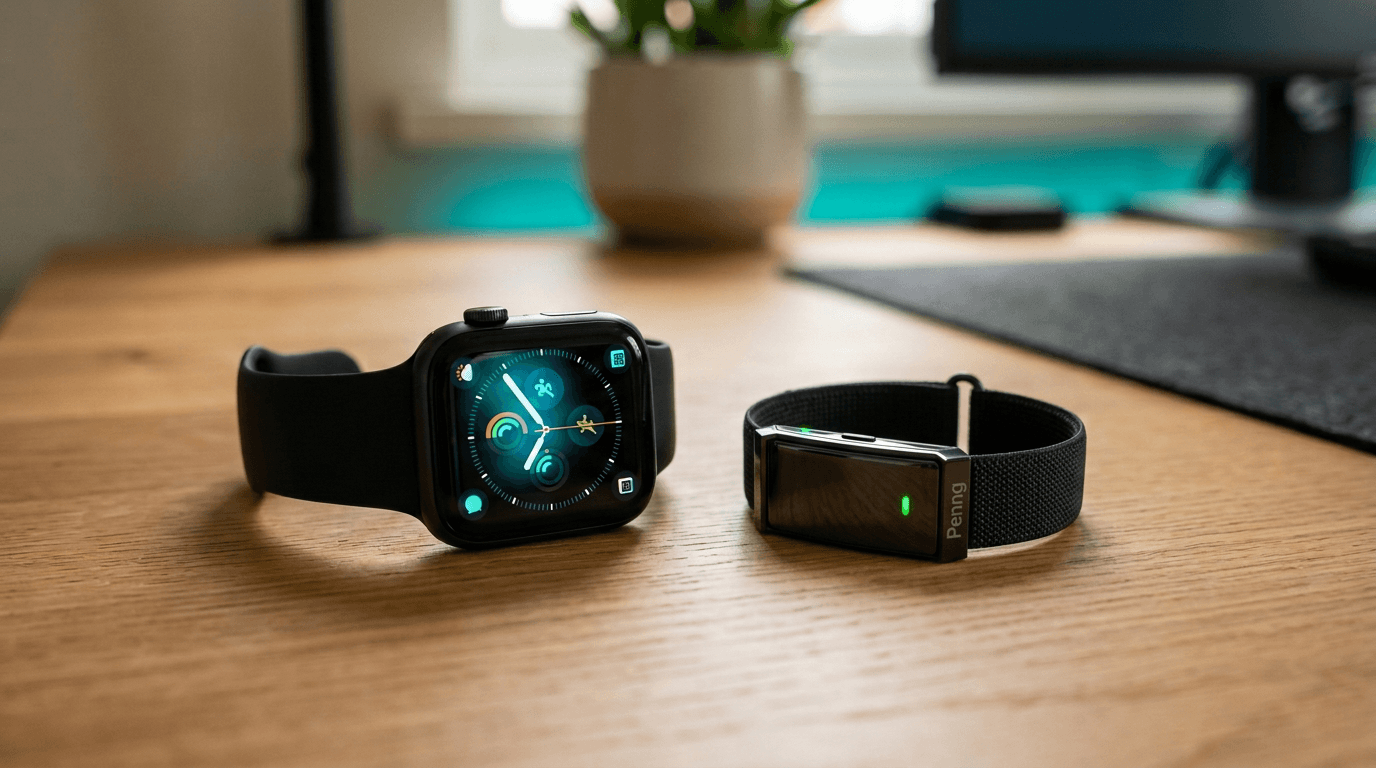
The Apple Watch is the world's best-selling smartwatch. It does everything: notifications, calls, apps, payments, navigation, music, and yes, health tracking. It's a miniature iPhone on your wrist.
Penng is a screen-free health band that does one thing: track your body. No notifications. No apps. No screen. Just recovery, strain, sleep, and AI-powered food tracking.
These aren't competing products in the traditional sense. One is a smartwatch that includes health features. The other is a health device that deliberately excludes smartwatch features. But if you're trying to decide which one will actually make you healthier, this comparison is worth reading.
The Fundamental Question
The Apple Watch is built on the premise that putting more technology on your wrist makes your life better. More information, more connectivity, more capability.
Penng is built on the opposite premise. That when it comes to health tracking, less technology on your wrist actually works better. No screen means no distractions. No notifications means no reason to check your wrist a hundred times a day. The data collects silently, and you engage with it on your phone when you're ready.
Both premises have merit. The question is which one matches how you want to interact with your health data.
If you want your wearable to replace your phone for quick interactions, the Apple Watch is clearly the answer. If you want your wearable to collect health data without adding another screen to your day, Penng is designed specifically for that purpose. For more on this philosophy, see why a screen-free fitness tracker might be exactly what you need.
Health Features: Apple Watch
The Apple Watch Series 10 and Apple Watch Ultra 2 offer a genuinely impressive health feature set:
- ECG - Single-lead electrocardiogram that can detect atrial fibrillation. This is a medical-grade feature that has literally saved lives.
- Blood oxygen (SpO2) - Continuous monitoring (though Apple has had regulatory issues with this feature in some markets).
- Heart rate - Continuous optical heart rate with high/low heart rate notifications.
- Temperature sensing - Wrist temperature tracking, primarily used for cycle tracking.
- Crash detection - Accelerometer and gyroscope-based detection that can automatically call emergency services.
- Fall detection - Alerts emergency contacts if you take a hard fall and don't respond.
- Sleep tracking - Sleep stages (Core, Deep, REM), respiratory rate, wrist temperature during sleep.
- Workout tracking - Auto-detect for common workouts, detailed sport-specific metrics.
- Mindfulness - Breathing exercises and reflection prompts.
Apple has also added a depth gauge and water temperature sensor to the Ultra 2, and the Double Tap gesture for hands-free interaction on Series 10.
There's no denying the Apple Watch has the widest health feature set of any consumer wearable. Some of these features (ECG, crash detection, fall detection) could genuinely save your life in an emergency.
Health Features: Penng
Penng focuses on a narrower but arguably deeper set of daily health metrics:
- Recovery score - 0-100% with green/yellow/red traffic-light system. Based on overnight HRV, resting heart rate, sleep quality, and SpO2.
- Strain score - 0-100 scale that accumulates throughout the day based on exertion.
- Sleep score - 0-100 with sleep stage breakdown (Light, Deep, REM).
- HRV - Overnight heart rate variability displayed as a morning value in milliseconds.
- Resting heart rate - Displayed in app.
- SpO2 - Blood oxygen percentage displayed in app.
- Steps and calories - Active and resting calories tracked throughout the day.
- AI food tracking - Five input methods: photo, barcode scan, text description, voice, and nutrition label photo.
- 109+ workout types - Manually started and ended in the app.
Penng does not have ECG, crash detection, fall detection, skin temperature, respiratory rate, or auto workout detection. These are real limitations. If you need an ECG on your wrist for medical reasons, Penng is not your device.
But what Penng does that the Apple Watch doesn't is combine recovery, strain, and nutrition data into a single integrated framework. The daily question Penng answers is: "How recovered am I, how hard have I pushed today, and what have I eaten?" The Apple Watch answers a different question: "What are my health vitals and what's happening on my phone?"
The Recovery Gap
Here's something most people don't realise about the Apple Watch: it doesn't have a great recovery metric.
Apple offers a "Vitals" feature that flags when your overnight metrics deviate from your normal ranges, and watchOS has various health insights. But there's no single, clear recovery score that tells you "you're 72% recovered today, train at moderate intensity." There's no strain score that quantifies your daily exertion.
You can piece together recovery insights from multiple Apple Health data points, or use third-party apps like Athlytic or Training Today. But out of the box, the Apple Watch doesn't give you a clear recovery-to-strain framework the way Penng (or WHOOP, or Oura) does.
Penng's entire design revolves around this framework. Your morning recovery score and your daily strain score work together to tell you whether you're training within your body's capacity or pushing beyond it.
Verdict: For recovery and strain tracking specifically, Penng provides a more focused and actionable daily framework out of the box.
Food Tracking
The Apple Watch has no built-in food tracking. None.
You can install third-party apps like MyFitnessPal, Lose It, or Cronometer on the Apple Watch, but these are basic companion apps that still require manual food logging. You're searching databases, selecting portion sizes, and typing entries. It's the same tedious process that makes 90% of people abandon food tracking within two weeks.
Penng's AI food tracking is built directly into the app with five input methods:
- Photo - Snap your meal and Gemini Vision AI identifies the food and estimates macros.
- Barcode scan - Scan packaged food for nutrition data from OpenFoodFacts.
- Text description - Type what you ate and AI parses the macros.
- Voice - Speak your meal description and speech-to-text feeds the AI parser.
- Nutrition label photo - Photograph a nutrition label and AI reads the values.
The app tracks calories, protein, carbs, fat, fibre, sodium, sugars, and provides a health score and confidence level for each entry. Having this integrated with your recovery and strain data means you can see how nutrition affects your recovery over time.
Verdict: Penng wins clearly. Built-in AI food tracking versus no food tracking isn't a close comparison.
Battery Life
This is where the comparison becomes almost absurd.
The Apple Watch Series 10 lasts approximately 18 hours on a single charge. With the always-on display disabled and low power mode enabled, you might stretch that to 36 hours. The Apple Watch Ultra 2 does better at roughly 36-72 hours depending on usage. But realistically, most Apple Watch users charge their watch daily.
Penng lasts approximately 21 days on a single charge. You charge it roughly twice a month.
This matters in two practical ways:
Sleep tracking: If your Apple Watch dies by bedtime (which happens often), you miss that night's sleep data. Some people develop the habit of charging their watch while they shower and hoping it has enough juice to get through the night. With Penng, you never think about this.
Data continuity: Every charging gap is a data gap. With the Apple Watch, you're creating daily gaps. With Penng, you're creating gaps roughly once every three weeks. More continuous data means better trend analysis over time.
Verdict: Penng wins by such a large margin that this category barely warrants discussion. 21 days versus 18 hours is not a comparison.
Distraction Factor
This is subjective but important.
The Apple Watch is, by design, an extension of your phone. Every text, every email, every social media notification, every news alert can appear on your wrist. Apple has added Focus modes and notification management features, but the default experience is one of constant connectivity.
Research consistently shows that wearable notifications increase the frequency of device checking. If you already feel like your phone demands too much of your attention, adding another screen that buzzes and lights up throughout the day may not improve your relationship with technology.
Penng has no screen. No notifications. No buzzing. It collects data silently, and you check the app when you choose to. The argument isn't that notifications are bad. The argument is that a health tracker doesn't need them to do its job.
Verdict: This is personal preference. But if reducing digital distractions is a goal, Penng is deliberately designed for that. The Apple Watch is not.
Ecosystem and Compatibility
The Apple Watch works exclusively with iPhones. If you have an Android phone, you cannot use an Apple Watch. Period.
Penng works with both iOS and Android. No ecosystem lock-in.
The Apple Watch integrates deeply with Apple Health, which is a powerful health data aggregator. Your Apple Watch data syncs seamlessly with other Apple devices and Apple Health-compatible apps. This integration is genuinely excellent.
Penng has its own app ecosystem. Your data lives in the Penng app. It's a simpler, more contained experience. Less integration flexibility, but also less complexity.
Verdict: Apple Watch offers deeper ecosystem integration but locks you into Apple. Penng works with both platforms.
Pricing
Apple Watch Series 10 starts at approximately R8,000 in South Africa. The Apple Watch Ultra 2 starts at approximately R15,000. Apple doesn't charge a subscription for health features.
However, the Apple Watch needs replacing every 3-4 years as Apple drops software support for older models. So your effective annual cost is R2,000-R5,000 depending on which model you buy and how often you upgrade.
Penng costs R1,950/year including the band and full membership. No separate hardware purchase. Everything is included. When your subscription renews, you continue with the same band.
Over three years:
- Apple Watch Series 10: ~R8,000 (assuming no upgrade needed within that period)
- Penng: R5,850
Over five years:
- Apple Watch: ~R16,000 (likely one upgrade cycle)
- Penng: R9,750
For a broader look at affordable options in South Africa, see our affordable fitness tracker guide.
Verdict: Penng is more affordable at every time horizon. But the Apple Watch gives you a lot more functionality beyond health tracking.
Head-to-Head Comparison Table
| Feature | Apple Watch Series 10 | Penng |
|---|---|---|
| Screen | Yes (OLED, always-on) | No (screen-free) |
| Battery | 18-36 hours | 21 days |
| Recovery score | No (basic Vitals) | Yes (0-100%, traffic light) |
| Strain score | No | Yes (0-100) |
| Sleep tracking | Yes (stages) | Yes (stages, HRV, SpO2) |
| Food tracking | No built-in | AI-powered, 5 methods |
| ECG | Yes | No |
| Crash/fall detection | Yes | No |
| Skin temperature | Yes | No |
| SpO2 | Yes | Yes |
| Notifications | Yes | No |
| GPS | Yes (on-device) | Phone GPS only |
| Water resistance | 50m (WR50) | 1 ATM (splash only) |
| Phone compatibility | iPhone only | iOS + Android |
| Weight | ~36-52g | ~40g |
| Price | ~R8,000+ (once-off) | R1,950/year |
Who Should Buy the Apple Watch
- People who want a full smartwatch experience (notifications, apps, payments, music)
- Anyone who needs ECG monitoring for medical reasons
- People who value crash detection and fall detection safety features
- Swimmers (50m water resistance)
- iPhone users who want deep Apple ecosystem integration
- People who want real-time metrics during workouts on their wrist
Who Should Buy Penng
- People whose primary goal is understanding recovery, strain, and nutrition balance
- Anyone who wants to reduce screen time and wearable distractions
- People who value 21-day battery life over daily charging
- Anyone who wants AI food tracking integrated with health data
- Android users (the Apple Watch doesn't work with Android)
- South African buyers who want ZAR pricing, local support, and no import fees
- Budget-conscious buyers who want health data without an R8,000+ investment
The Bottom Line
The Apple Watch is the best smartwatch on the market. If you want a device that does everything, including health tracking, it delivers more features than anything else you can put on your wrist. The ECG, crash detection, and fall detection features are genuinely valuable, potentially life-saving capabilities that no screen-free tracker can match.
Penng is a better dedicated health tracker for daily recovery, strain, and nutrition management. The 21-day battery means you actually wear it continuously. The AI food tracking means you actually log what you eat. The screen-free design means you actually disconnect from notifications. And the R1,950/year price tag means the financial barrier is significantly lower.
The right choice depends on a simple question: do you want a smartwatch that also tracks health, or a health tracker that only tracks health? For more options at different price points, check our best fitness tracker for South Africa guide.
Frequently Asked Questions
Does the Apple Watch have a recovery score?
The Apple Watch does not have a built-in recovery score comparable to Penng, WHOOP, or Oura. Apple's Vitals feature flags overnight metric deviations, and various third-party apps (Athlytic, Training Today) can generate recovery scores using Apple Health data. But out of the box, there's no single daily recovery number.
Can I track food on the Apple Watch?
Not natively. The Apple Watch has no built-in food tracking. You can install third-party apps like MyFitnessPal or Lose It, but these use traditional manual food logging. Penng offers AI-powered food tracking with five input methods (photo, barcode, text, voice, nutrition label) built directly into the app.
Is the Apple Watch worth it just for health tracking?
If health tracking is your only goal, the Apple Watch is expensive for what it delivers. Most of its cost goes toward smartwatch features (screen, apps, connectivity) rather than health sensors. A dedicated health tracker like Penng costs significantly less and provides deeper recovery, strain, and nutrition data. The Apple Watch's unique health advantages are ECG, crash detection, and fall detection.
Can Penng work with an iPhone?
Yes. Penng works with both iOS and Android. Unlike the Apple Watch, which is locked to iPhone, Penng doesn't restrict you to any phone ecosystem.
How often do you need to charge each device?
The Apple Watch Series 10 typically needs daily charging (18-36 hours of battery life). Penng needs charging approximately every 21 days. In practical terms, you'll charge your Apple Watch 300+ times per year versus about 17 times for Penng.
Wondering if you need a smartwatch or just better health data? Take the free quiz at penng.ai/quiz to discover which approach matches your goals.