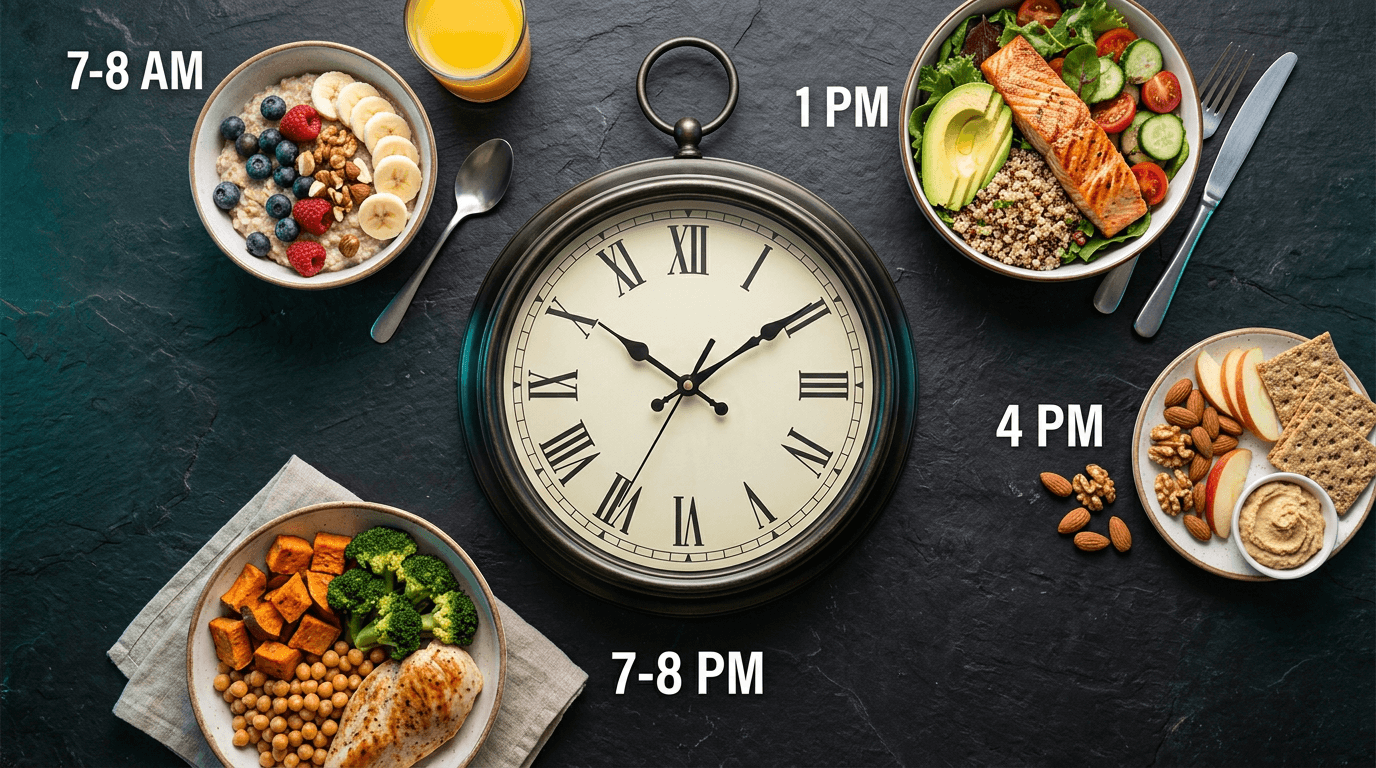
The fitness world has spent decades arguing about meal timing. Eat every two hours to "stoke the metabolic fire." Never eat after 8pm or it turns to fat. Skip breakfast with intermittent fasting. Consume protein within 30 minutes of training or your workout was wasted.
Most of these claims range from oversimplified to outright false.
But buried in the noise, there is real science about nutrient timing — and the answer is more nuanced than "it does not matter at all." Total daily intake matters most. Timing matters second. And for certain scenarios, timing matters meaningfully.
Here is what the research actually says, stripped of the marketing and dogma.
The Hierarchy of What Matters
Sports nutrition researchers have established a clear hierarchy for dietary factors that influence body composition and performance:
- Total calorie intake — the single most important factor
- Macronutrient ratios — how much protein, carbs, and fat you eat
- Food quality — whole foods vs processed foods, micronutrient density
- Meal timing and frequency — when and how often you eat
- Supplements — the smallest lever by far
Notice where timing sits: fourth. Not irrelevant, but distinctly less important than getting your total intake and macro ratios right first.
If you are eating 1,200 calories of junk food, optimising your meal timing will not save you. If you are eating adequate calories with solid macros from quality food, timing might give you an extra 5-10% edge. That edge matters for competitive athletes. For most people, it is a refinement, not a foundation.
The Metabolic Fire Myth
The idea that eating small, frequent meals "stokes your metabolism" was pervasive in fitness culture through the 2000s and 2010s. The logic seemed intuitive: eating causes a thermic effect (your body burns calories digesting food), so eating more frequently means more thermic events, which means more calories burned.
The research does not support this.
A 2010 study by Cameron et al. compared three meals per day versus six meals per day with identical total calories and macros. No difference in metabolic rate. No difference in fat loss. No difference in muscle retention.
The thermic effect of food (TEF) accounts for roughly 10% of your total calories consumed, regardless of whether you eat them in three meals or six. Eating 2,400 calories across six meals means six small thermic events. Eating 2,400 calories across three meals means three larger thermic events. The total is the same.
The takeaway: Eat as many or as few meals as suits your schedule and preference. There is no metabolic advantage to eating every two or three hours.
The 8pm Myth
"Do not eat carbs after 6pm" or "eating late makes you fat" are among the most persistent nutrition myths. The reasoning is that your metabolism slows at night, so food eaten late is more likely to be stored as fat.
This is not how metabolism works.
Your body does not have a switch that flips to "fat storage mode" at a specific time. A calorie eaten at 9pm is metabolised the same way as a calorie eaten at 9am. What matters is your total daily energy balance, not the clock.
There is a grain of truth buried here: people who eat late at night often make poor food choices (snacking on crisps, biscuits, ice cream). The timing is not the problem — the food quality and excess calories are.
Some shift workers may experience metabolic disruptions from eating during biological night (when your circadian rhythm expects you to be asleep), but this is a circadian rhythm issue, not a "food turns to fat after 8pm" issue.
The takeaway: Eat when it suits your schedule. If you train in the evening and dinner is at 9pm, that is fine. Your body does not know what time it is.
Pre-Workout Nutrition: What Actually Helps
This is where timing starts to genuinely matter. Training performance is measurably affected by what you ate (or did not eat) in the hours before.
Training Fasted vs Fed
Fasted training (no food for 8+ hours before exercise) is popular with intermittent fasting advocates. The theory is that low insulin levels force your body to burn fat for fuel.
The reality: research shows that while fat oxidation is slightly higher during fasted exercise, total fat loss over days and weeks is not different between fasted and fed training when calories are equal (Schoenfeld, 2014). Your body compensates later. If you burn more fat during a fasted morning session, you burn slightly less fat the rest of the day.
Fasted training has a clear downside: reduced performance. Studies consistently show that high-intensity and resistance training performance drops when glycogen stores are depleted. You cannot train as hard, you fatigue faster, and you produce less total volume. For steady-state cardio, the difference is smaller.
If performance matters to you, eat before training.
What to Eat Pre-Workout
2-3 hours before: A normal meal with carbs, protein, and moderate fat. Examples: chicken with rice and vegetables, pasta with meat sauce, oats with eggs.
30-60 minutes before: Something lighter and easily digestible. Low fat, moderate carbs, some protein. Examples: a banana with a few bites of biltong, toast with honey, a small yoghurt, a protein shake with fruit.
The key nutrient is carbs. Carbohydrates top up your muscle glycogen stores, which are your primary fuel source for moderate to high-intensity exercise. Protein is secondary but helpful for reducing muscle breakdown during training.
Fat slows digestion, so keep it low in the 30-60 minute window to avoid stomach discomfort during training.
Post-Workout Nutrition: The Window is Wider Than You Thought
The "anabolic window" — the idea that you must consume protein within 30 minutes of training to maximise muscle growth — was a cornerstone of gym bro science for decades. It drove an entire industry of post-workout shake marketing.
The research tells a more relaxed story.
Schoenfeld and Aragon's 2018 meta-analysis found that the post-exercise window for muscle protein synthesis is significantly wider than 30 minutes. The window likely extends 4-6 hours, and possibly longer. What matters most is that you consume adequate protein sometime in the hours surrounding your training — before, after, or both.
If you ate a meal 2-3 hours before training, your body still has amino acids circulating from that meal. There is no urgency to consume protein the moment you rack your last set.
If you trained fasted, getting protein in sooner (within 1-2 hours) makes more sense, because your body has been without amino acid input for longer.
What to Eat Post-Workout
The classic recommendation of protein + carbs after training still holds, just without the rigid time pressure:
- Protein: 20-40g to support muscle protein synthesis
- Carbs: Replenish glycogen stores, especially if you trained intensely or will train again within 24 hours
- Fat: Not critical immediately post-training, but does not need to be avoided
Practical post-workout meals:
- Grilled chicken with sweet potato and salad
- Protein shake with a banana
- Eggs on toast
- Greek yoghurt with fruit and granola
- Biltong with a handful of dried fruit
The emphasis on immediate post-workout nutrition is largely overblown for recreational exercisers. Eat a normal meal within a few hours of training and you will be fine.
Intermittent Fasting: The Evidence
Intermittent fasting (IF) — typically a 16:8 pattern (16 hours fasting, 8-hour eating window) — has become enormously popular. The claimed benefits range from fat loss to longevity to improved insulin sensitivity.
What does the research say?
For fat loss: IF works, but not because of any metabolic magic. It works because restricting your eating window makes it harder to overeat. When you compress meals into 8 hours, most people naturally consume fewer calories. When studies control for calories (same intake, IF vs traditional eating), fat loss results are identical.
For muscle retention: This is where IF can become a problem. If you are training hard and trying to maintain or build muscle, cramming 150+ grams of protein into an 8-hour window is challenging. Research suggests that distributing protein across 3-5 meals optimises muscle protein synthesis. With IF, you might only have 2-3 meals, making each one uncomfortably large.
For health markers: Some evidence supports IF for insulin sensitivity and inflammation markers, but these benefits may be driven by calorie restriction rather than the fasting pattern itself. The jury is still out.
The practical verdict: IF is a tool, not a superior strategy. If it helps you control your calories and fits your lifestyle, great. If it compromises your training performance or makes it hard to hit your protein targets, it is doing more harm than good. Be honest about which category you fall into.
Meal Frequency: Finding Your Rhythm
How many meals per day should you eat? Research suggests it barely matters for body composition, as long as total intake and macros are consistent. Three meals, four meals, six meals — all produce similar results.
But there are practical considerations:
For muscle building: 3-5 protein-containing meals spread throughout the day is likely optimal. Each meal should contain 0.4-0.55g of protein per kilogram of body weight to maximally stimulate muscle protein synthesis.
For fat loss: Some people do better with fewer, larger meals (feeling satisfied after each). Others prefer more frequent, smaller meals (never getting too hungry). Neither is objectively better. Choose what helps you stick to your calorie target.
For performance: If you train in the afternoon, having a substantial meal at lunch ensures you have fuel. If you train in the morning, a pre-training snack or meal the night before matters more.
The best meal frequency is the one that fits your life, helps you hit your targets, and does not make you miserable.
How Tracking Reveals Your Personal Patterns
Here is where the theoretical becomes practical: everyone responds slightly differently to meal timing. Some people perform noticeably better with a solid pre-workout meal. Others are fine training fasted. Some people sleep poorly after a large late dinner. Others need a bedtime snack or they wake up hungry.
The only way to know what works for you is to track it and look at the data.
When your nutrition data and body data live in the same system, patterns emerge. You might notice that your recovery score is consistently higher on mornings after you had a protein-rich dinner. Or that your sleep score drops when you eat within an hour of bed. Or that training performance correlates with your carb intake 2-3 hours beforehand.
Penng captures both sides — what you eat (via AI food tracking) and how your body responds (recovery, sleep, strain). Over a few weeks, the data starts telling a story that generic timing advice cannot. Your body has its own preferences. Data helps you discover them instead of guessing.
This does not mean obsessing over every variable. It means making observations over time and noticing what consistently produces better results for you specifically.
Practical Meal Timing Guidelines
If you want actionable advice without the complexity:
- Eat a protein-containing meal every 3-5 hours during your waking hours. This ensures good protein distribution.
- Eat a meal with carbs and protein 2-3 hours before training. If that is not possible, have a small snack 30-60 minutes before.
- Eat a normal meal within a few hours after training. No need to rush to the protein shake.
- Do not skip meals to "save calories" for later. This usually backfires with poor choices and overeating.
- Eat when you are hungry, stop when you are satisfied. This sounds obvious, but many people override these signals based on rigid timing rules.
- If you eat late, choose quality food. The clock is not the problem. The crisps are.
The Bottom Line
Total daily intake trumps timing. Every time. Get your calories, macros, and food quality right first. Those are the foundations.
Once the foundations are solid, timing can refine your results. Eating protein across multiple meals is better than one massive dose. Eating carbs before training improves performance. Having protein and carbs after training supports recovery. These are real but secondary effects.
Do not let meal timing become a source of stress. The person who eats the right amount of quality food at "imperfect" times will always outperform the person who eats poorly at "perfect" times.
Frequently Asked Questions
Does eating after 8pm make you fat?
No. Your body metabolises food the same way regardless of the time. Weight gain comes from consistently eating more calories than you burn over time, not from when those calories are consumed. The association between late-night eating and weight gain is driven by poor food choices during evening snacking, not by the clock itself.
Should I eat before or after a workout?
Ideally both, though the timing does not need to be rigid. A meal with carbs and protein 2-3 hours before training fuels performance. A meal with protein and carbs within a few hours after training supports recovery. If you train first thing in the morning and cannot eat beforehand, prioritise a post-workout meal within 1-2 hours.
Is intermittent fasting good for fat loss?
Intermittent fasting can help with fat loss because it naturally restricts your eating window, making it harder to overeat. However, when calories are matched, IF produces the same fat loss results as traditional eating patterns. It is a tool for calorie control, not a metabolic hack. If it makes you feel restricted or compromises your training, it is not the right approach for you.
How many meals per day should I eat?
Research shows little difference in body composition between three, four, or six meals per day when total intake is the same. For muscle building, spreading protein across 3-5 meals may be slightly beneficial. For fat loss, choose the meal frequency that helps you control calories most comfortably. The best schedule is the one you can maintain consistently.
Does the post-workout anabolic window exist?
The "30-minute anabolic window" has been overstated. Research shows the window for muscle protein synthesis extends at least 4-6 hours after training. If you ate a meal a few hours before training, there is no urgency to consume protein immediately after. What matters most is adequate total daily protein intake distributed across multiple meals.
Take the free quiz at penng.ai/quiz to discover how your eating patterns align with your training schedule and recovery needs.