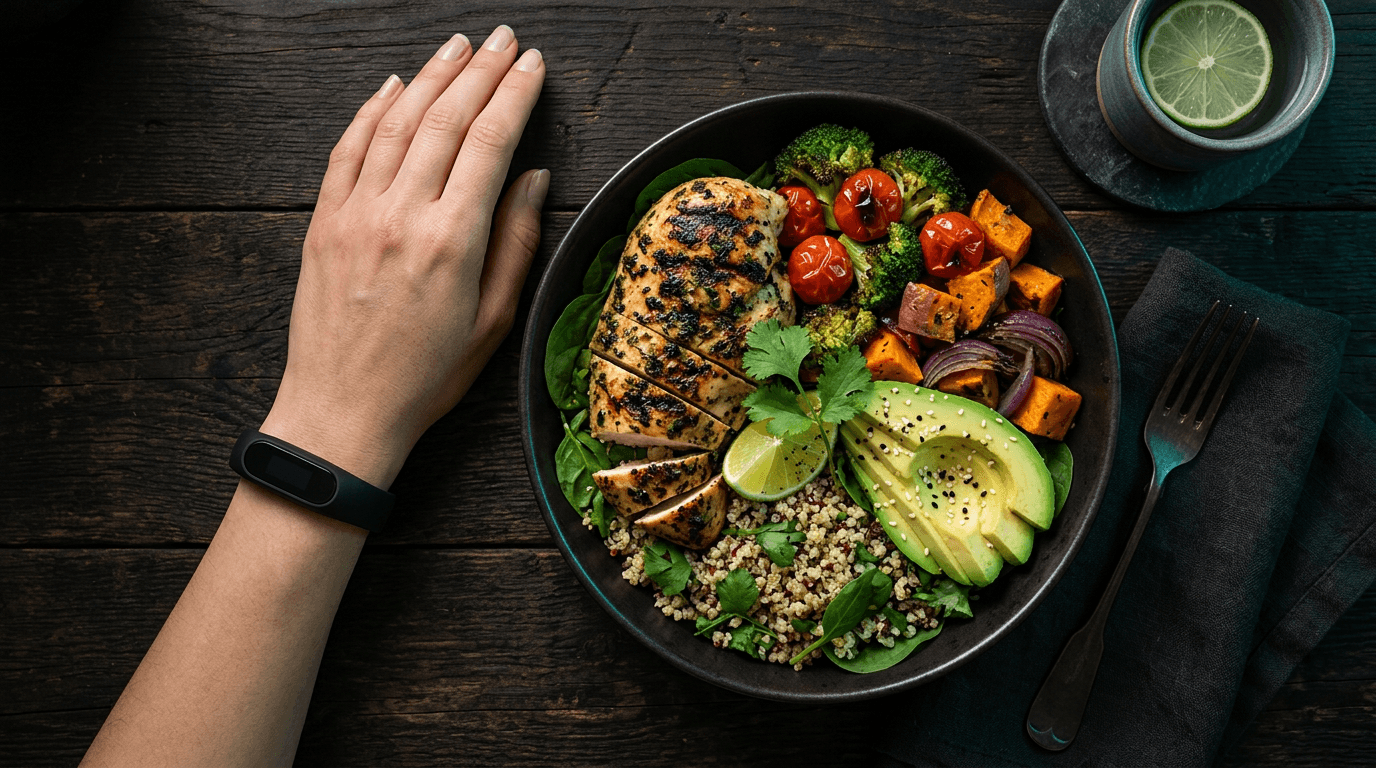
Every fitness wearable on the market will tell you how many calories you burned. Apple Watch does it. Garmin does it. Fitbit does it. WHOOP does it.
None of them tell you how many calories you ate.
That is like tracking your bank account by only looking at your salary and ignoring every purchase. You know money is coming in. You have no idea where it is going. The number on the screen means nothing without both sides.
The Calories Out Problem (Mostly Solved)
Wearable calorie burn tracking has gotten genuinely good. Continuous heart rate monitoring combined with accelerometer data and body metrics gives you a reasonable estimate of total daily energy expenditure.
It is not perfect. Wrist-based optical HR sensors struggle with certain exercises, particularly weight training. But for daily calorie burn, the estimates from modern wearables land within 10-15% of lab-measured values. Good enough to be useful.
This side of the equation is handled. Your wearable knows roughly what your body spent today.
The Calories In Problem (Mostly Ignored)
The input side is where the entire industry drops the ball.
Your Garmin does not know you had a croissant for breakfast. Your Apple Watch did not see the handful of cashews at 3pm. Your WHOOP has no idea you skipped lunch and then ate a massive dinner.
So they all punt the problem to third-party apps. "Sync with MyFitnessPal." "Connect to Lose It." "Log your food manually."
Which brings you right back to manual food logging. The thing that 95% of people quit within two weeks.
The calorie equation has two sides. The industry built excellent tools for one side and a broken workflow for the other. Then they told you the broken part was your responsibility.
What Automatic Calorie Tracking Actually Looks Like
True automatic calorie tracking means reducing the input friction to nearly zero. Not eliminating user involvement entirely (no wearable can detect what you ate through your skin). But making the process so fast it barely registers as effort. We cover what to look for in an AI food tracking app in more detail.
Photo Recognition. You take a photo of your plate. Computer vision identifies the foods, estimates portion sizes based on plate geometry and food density, and pulls nutritional data. The whole thing takes five seconds. The AI improves over time as it learns your regular meals and portion patterns.
Barcode Scanning. For packaged food, the barcode contains everything. Scan it. Two seconds. Nutritional data pulled from product databases covering South African, UK, US, and international products.
Natural Language Input. Type "chicken mayo sandwich and a Coke" and the AI parses each component, matches it against food databases, and returns a total. No dropdowns. No scrolling through fifteen versions of "chicken breast."
Multi-Database Cross-Referencing. This is where it gets technical. A single food description gets checked against multiple nutritional databases simultaneously. The system accounts for regional variations. A "pie" in South Africa is not the same as a "pie" in America. Local products, local ingredients, local brands. For more on how this works with South African food specifically, see our guide to food tracking in South Africa.
Learning Over Time. The system recognises your patterns. If you eat the same breakfast most weekdays, it suggests it before you even start logging. Your most frequent meals become one-tap entries.
Both Sides of the Equation, One Device
When you track calories in and calories out from the same device, something useful happens. The data connects.
You can see that on days you eat below 1,800 calories, your recovery score the next morning drops. You can see that high-protein days correlate with better sleep scores. You can see that skipping meals before training tanks your strain capacity.
These are not hypothetical insights. They are patterns that emerge from your actual data once both sides of the equation are captured in the same system.
Separate apps cannot do this. MyFitnessPal does not talk to your WHOOP in any meaningful way. The data lives in silos. You are left to manually cross-reference your food log with your recovery data and draw your own conclusions.
What Penng Replaces
If you are currently using a combination of tools, Penng consolidates them.
- MyFitnessPal Premium (R1,200/year for barcode scanning and meal analysis). Penng includes AI food tracking with photo recognition, barcode scanning, and text input. Built in.
- WHOOP ($199 to $359/year depending on tier, roughly R4,200 to R7,200 landed in SA, for strain, recovery, and sleep). Penng tracks strain, recovery, and sleep scores from the same band. R1,950/year. See our full breakdown of whether WHOOP is worth it for more detail.
- A separate food scale and measuring cups. The AI estimates portions from photos. Not required.
One band. One subscription. Both sides of the calorie equation. Strain, recovery, and sleep included. 21-day battery. 40 grams on your wrist. No screen buzzing at you during dinner.
The Point
Calories in versus calories out is still the fundamental equation for body composition. That has not changed and will not change regardless of what any diet influencer tells you.
What has changed is that you no longer need to spend 23 minutes a day on manual data entry to track it. The technology caught up. AI food recognition is accurate enough, fast enough, and convenient enough to make calorie tracking viable for normal people with normal lives.
Not just athletes. Not just bodybuilders. Normal people who want to understand what they eat without making it a part-time job.
That is what automatic calorie tracking actually means. Not a wearable that magically knows what you ate. A system so fast and simple that the tracking becomes invisible.
Frequently Asked Questions
What does automatic calorie tracking mean?
Automatic calorie tracking means reducing the effort of logging food to near zero. Instead of manually typing every ingredient, you snap a photo of your plate, scan a barcode, type a quick description, use voice input, or photograph a nutrition label and the system parses it automatically.
Can a wearable detect what I eat?
No wearable can detect food through your skin. Automatic refers to the speed and ease of input through photo recognition, barcode scanning, and natural language processing. The wearable tracks your calorie burn while the companion app handles food input.
How does AI food photo recognition work?
You photograph your plate. Computer vision identifies the individual foods, estimates portion sizes based on plate geometry and food density, and cross-references nutritional databases to calculate calories and macros. The AI improves with use as it learns your regular meals.
Is it worth tracking both calories in and calories out?
Yes. Tracking only calories burned is like checking your salary but ignoring your spending. When both sides are captured in the same system, you can see how nutrition affects your recovery, sleep quality, and training readiness.
Take the free quiz at penng.ai/quiz to see how your nutrition stacks up against your training load.