Try logging a vetkoek in MyFitnessPal.
You will find 47 entries. Some say 200 calories. Some say 500. One says 800. Half of them are labelled "South African Vetkoek" and the other half are just called "fried dough." The serving sizes range from 50g to 200g. None of them match the one your mom makes.
This is the fundamental problem with food tracking in South Africa: the apps were not built for us.
The dominant food tracking platforms — MyFitnessPal, Lose It, Cronometer, FatSecret — are designed primarily for the American market. Their databases are packed with US brands, US restaurant chains, US portion sizes, and US naming conventions. They work reasonably well if you eat Kraft mac and cheese and shop at Walmart. They fall apart when you eat pap and wors at a braai.
This is not a minor inconvenience. It makes food tracking unreliable for millions of South Africans who want to manage their nutrition but cannot find their actual food in the database.
Here is why South African food tracking is uniquely challenging, what works, and how to get accurate data without spending twenty minutes per meal on data entry.
Why Most Food Tracking Apps Fail in South Africa
Problem 1: Local Brands Are Missing
South African grocery shelves look nothing like American ones. We buy Koo baked beans, not Bush's. We buy Sasko bread, not Wonder Bread. We buy Clover yoghurt, not Chobani. We drink Rooibos, not Lipton.
Most food tracking databases have limited coverage of South African brands. When you scan a barcode of an Enterprise polony or a Bakers biscuit, you might get a result — or you might get nothing. When you do get a result, it may have been user-submitted with questionable accuracy.
The bigger US databases have millions of entries, but the South African subset is thin. You end up substituting American products that are "close enough," which introduces errors that compound across every meal.
Problem 2: Traditional Foods Have No Standard Entry
How many calories are in a koeksister? It depends on the recipe, the size, whether it is a Cape Malay koeksister (more like a doughnut) or the braided syrup-coated kind. There is no standardised answer because koeksisters are not manufactured in a factory with a consistent recipe — they are made at home, at church bazaars, and at roadside stalls.
The same problem applies to:
- Bobotie — ingredients vary enormously between families
- Bunny chow — portion size depends on the restaurant, the bread, and the filling
- Potjiekos — every pot is different
- Boerewors — fat content ranges from 20% to 40% depending on the butcher
- Biltong — wet, dry, fat-trimmed, fat-on, lean, fatty — the calorie range is wide
- Droewors — similar to biltong but different texture and fat content
- Melktert — homemade vs store-bought are different foods nutritionally
- Pap — preparation (stiff pap, soft pap, krummelpap) changes the calorie density significantly
These are foods millions of South Africans eat regularly. In most tracking apps, they either do not exist or have wildly inaccurate entries.
Problem 3: Braai Culture Is Hard to Track
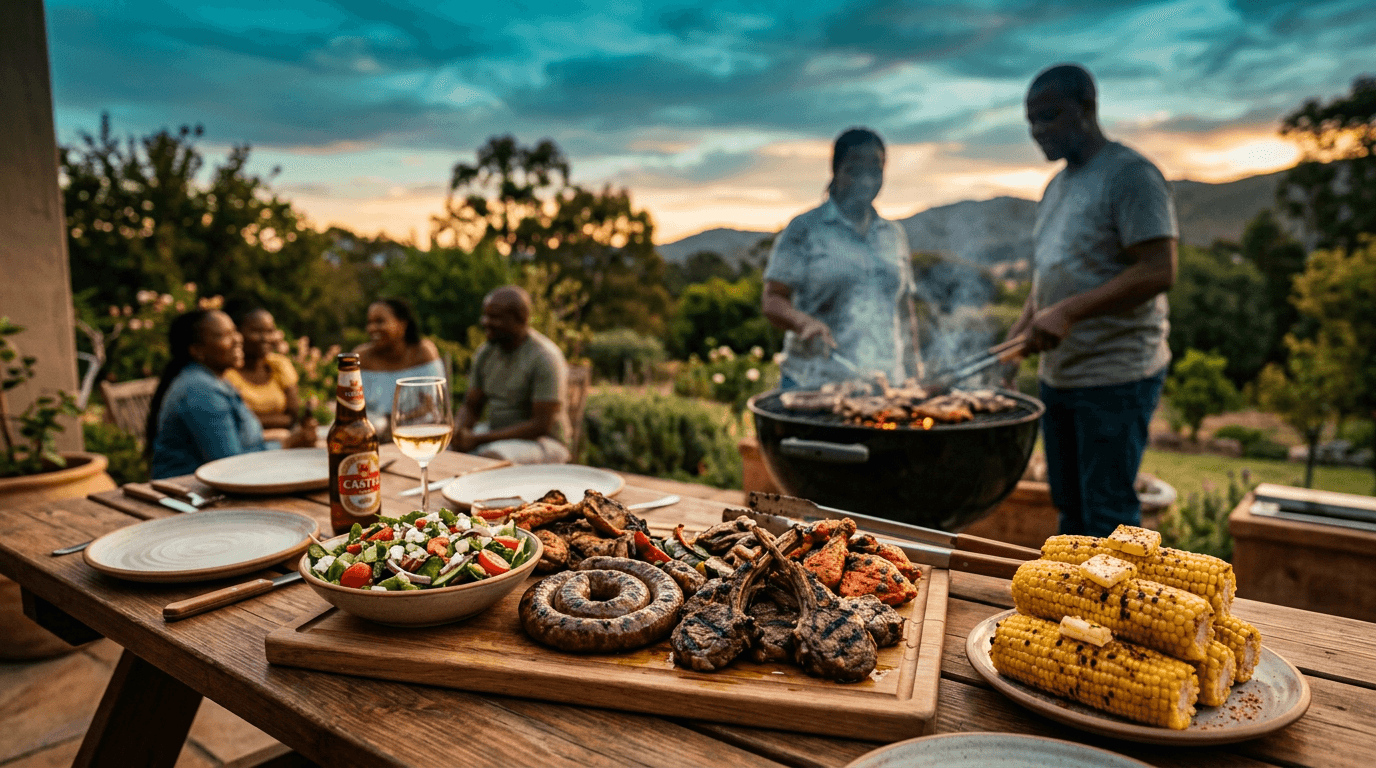
A braai is not a meal — it is an event. Meat goes on at noon. People eat intermittently for hours. There are sides (pap, braaibroodjies, salads, rolls). There are drinks. There is dessert.
Trying to log a braai meal in a traditional food tracker requires estimating the weight of every piece of meat you ate (who weighs their chops at a braai?), accounting for marinades and sauces, remembering exactly how many braaibroodjies you had, and somehow quantifying "a few handfuls of crisps and some biltong."
It is a tracking nightmare. Most people either skip logging braai meals entirely (creating gaps in their data) or make such rough estimates that the numbers are meaningless.
Problem 4: Restaurant and Takeaway Limitations
South African restaurant chains are not well-represented in international food databases. Nando's appears in some databases (thanks to their international presence), but try finding accurate entries for:
- Spur
- Ocean Basket
- Steers
- Wimpy
- RocoMamas
- Galito's
- King Pie
- Roman's Pizza
Some of these chains publish limited nutritional information on their websites or packaging. Most do not. And even when they do, the data is often buried in PDFs that tracking apps do not reference.
Problem 5: Currency and Relevance
This is a smaller but real friction point. Most food tracking apps are priced in USD. MyFitnessPal Premium is $19.99/month — which converts to roughly R360/month or R4,320/year at current exchange rates. For a country where the average household income is significantly lower than the US, this pricing is prohibitive for many South Africans.
Additionally, the in-app recommendations, meal plans, and content are US-centric. Recommended meals use American ingredients. Suggested restaurants are American chains. The entire experience feels like it was built for someone else, because it was.
How South African Food Databases Are Improving
The landscape is getting better, slowly.
OpenFoodFacts
OpenFoodFacts is an open-source, community-driven food database that has been growing its South African product coverage significantly. Because it is community-contributed, South Africans have been adding local products with barcode data, nutritional information, and product photos.
It is not comprehensive yet, but it covers many common supermarket products from Woolworths, Pick n Pay, Checkers, and Spar. The database is freely accessible and used by several food tracking apps as a data source.
South African Medical Research Council (SAMRC) Food Composition Tables
The SAMRC maintains food composition tables specifically for South African foods. These include traditional dishes, local ingredients, and regionally specific preparations. While not integrated into most consumer apps, they represent the most authoritative nutritional data for South African foods.
AI-Powered Recognition
This is where the technology gap is closing fastest. AI food recognition does not rely on database entries — it identifies food from photos and estimates nutrition based on visual analysis. A plate of pap, wors, and chakalaka does not need to exist in a database. The AI recognises the components visually and estimates portions and macros.
This is inherently more South Africa-friendly than database lookup. The AI does not care whether the food is American or South African. It sees food, identifies it, and estimates nutrition.
What Actually Works for Tracking SA Food
Method 1: AI Photo Recognition
The fastest and most practical method for South African meals. Take a photo of your plate. The AI identifies the food items, estimates portion sizes based on visual cues, and pulls nutritional data.
This works particularly well for:
- Braai plates (the AI can identify different meats, sides, and portions)
- Traditional dishes (bobotie, curry, potjie — visual identification does not require a database entry)
- Restaurant meals where nutritional data is not published
- Home-cooked meals where ingredients vary from the "standard" recipe
The accuracy is not perfect — no food tracking method is. But it is fast (5 seconds), eliminates the need to search databases, and handles South African food without any special setup.
Method 2: Barcode Scanning With OpenFoodFacts
For packaged food from South African retailers, barcode scanning using OpenFoodFacts data has become increasingly reliable. Scan the barcode on your Enterprise biltong, your Koo baked beans, or your Sasko bread and get nutritional data standardised per 100g.
Coverage is not complete — you will still encounter products that are not in the database. But it is expanding as more South African users contribute data.
Method 3: Text or Voice Description
Describe what you ate in plain language: "boerewors roll with mustard and a glass of Coke." The AI parses each component, matches against nutritional databases, and returns a total. Voice input works the same way — speak your meal description and the system transcribes and processes it.
This is faster than searching databases manually and handles South African food names that might not appear in traditional search interfaces.
Method 4: Nutrition Label Photos
For packaged food where the barcode is not in the database, you can photograph the nutrition label directly. The AI reads the label and extracts the values. This works well for South African products where the label follows SA food labelling regulations (which require per 100g nutritional information).
Method 5: Learning From Your Patterns
The most effective long-term approach is a system that learns your eating patterns. If you eat the same breakfast most weekdays, you should only need to log it once. Subsequent instances should be suggested automatically.
This turns daily tracking from a series of new inputs into a series of confirmations: "Did you have your usual oats and eggs?" Yes. Done. Two seconds.
Penng's Approach to South African Food
Penng uses all five input methods — photo, barcode, text, voice, and nutrition label photo — powered by AI that cross-references multiple databases including OpenFoodFacts (which has South African products) and Gemini Vision AI for photo recognition.
The multi-database approach means that a food item does not need to exist in any single database. If the barcode is not found, the AI can still identify it visually. If the visual recognition is uncertain, text or voice description provides a fallback. The system assigns a confidence level (high/medium/low) to each entry so you know how reliable the estimate is.
Because Penng is South African (headquartered in Cape Town, priced in ZAR at R1,950/year), there is an inherent advantage in understanding the local market. The pricing is in Rands — no currency conversion, no import premium. And the development team eats South African food, which means local dishes and products are a priority rather than an afterthought.
For context, a MyFitnessPal Premium subscription costs approximately R4,320/year — and that is just the food tracking app. Penng includes food tracking, a physical wearable band, recovery tracking, sleep tracking, strain monitoring, and calorie burn tracking for R1,950/year. For South Africans watching their budgets, the value equation is straightforward.
That said, Penng is a newer product (launched 2025) and its AI food database is still growing. It will not identify every South African product perfectly. The AI is strong with common foods and meals, but obscure regional specialities or very unusual preparations may require manual input. We are honest about this — the system improves with use, but it is not claiming perfection.
Practical Tips for Tracking South African Meals
At a Braai
Do not try to track every morsel in real time. Take a photo of your plate when you sit down with your main serving. This captures the bulk of what you ate. If you go back for seconds, snap another photo. Ignore the handful of crisps and the few bites of biltong during the social phase — trying to capture every nibble is a path to madness.
Accuracy for a braai meal will never be perfect. An estimate that is 80% accurate is infinitely more useful than no data at all.
At Restaurants
Take a photo of your meal when it arrives. If the restaurant has an online menu with nutritional information, great — use it. If not (which is most SA restaurants), the photo method is your best option. The AI will identify the main components and provide a reasonable estimate.
For chain restaurants (Nando's, Spur, Ocean Basket), check their websites for nutritional data first. Nando's in particular publishes comprehensive nutritional information for their menu.
For Home-Cooked Meals
The easiest approach is to photograph your plate. For frequently prepared meals, log it once accurately and then reuse that entry. Most families rotate through 10-15 regular meals — once those are logged, daily tracking becomes mostly repetitive.
For complex recipes (potjiekos, bobotie), you can describe the ingredients in text and let the AI estimate. This will not be as precise as weighing every ingredient, but it gives you a workable estimate for a home-cooked meal.
For Traditional Foods
Pap: A 200g serving of stiff pap (the size of a fist) contains roughly 140-160 calories, primarily from carbohydrates. Soft pap has more water and fewer calories per serving.
Biltong: Roughly 55g protein and 250-280 calories per 100g for lean beef biltong. Fattier cuts or moist biltong will have more calories from fat.
Boerewors: Approximately 250-300 calories per 100g cooked, with 20-30g fat. It is calorie-dense — a single coil can easily be 500+ calories.
Droewors: Similar protein content to biltong but slightly different fat profile. Roughly 300-350 calories per 100g.
Braaibroodjies: Approximately 300-400 calories each depending on the amount of cheese, butter, and fillings.
Koeksisters: The traditional braided variety ranges from 200-350 calories each depending on size. The syrup soaking adds significant sugar and calories.
Knowing these rough numbers helps you make better estimates even when the tracking app is uncertain.
The Honest Assessment
Food tracking in South Africa is harder than in the US or UK. There is no way around this. Local food databases are smaller. Traditional dishes vary widely. Braai culture resists precise measurement.
But it is not impossible, and it is getting significantly easier. AI-powered food recognition bridges the database gap. Community-driven databases like OpenFoodFacts are growing their SA coverage. And South African products like Penng are building tools specifically for this market rather than trying to retrofit American solutions.
The goal is not perfection. It is consistency and reasonable accuracy. If you can track your meals with 80% accuracy most days, that is enough to see patterns, make informed adjustments, and achieve your nutrition goals — whether that is fat loss, muscle gain, or just understanding what you eat.
The biggest barrier to food tracking in South Africa was always that the available tools were not built for us. That is finally changing.
Frequently Asked Questions
Why do most food tracking apps not work well in South Africa?
Most popular food tracking apps (MyFitnessPal, Lose It, Cronometer) were built for the American market. Their databases are dominated by US brands, US restaurants, and US portion conventions. South African brands, traditional foods, and local restaurant chains are poorly represented, leading to missing entries, inaccurate substitutions, and a frustrating user experience for South African users.
How do I track traditional South African foods like pap, bobotie, and biltong?
AI photo recognition is the most practical method. Take a photo of your plate and let the AI identify the components and estimate portions. For frequently eaten meals, log them once and reuse the entry. For packaged SA products like biltong brands, barcode scanning with OpenFoodFacts is increasingly reliable. Knowing approximate calorie values for common foods (biltong: ~250-280 cal/100g lean, pap: ~140-160 cal/200g, boerewors: ~250-300 cal/100g) helps you verify AI estimates.
Is Penng better than MyFitnessPal for South African users?
Penng has some advantages for SA users: it is priced in ZAR (R1,950/year including a wearable band vs ~R4,320/year for MyFitnessPal Premium alone), built in South Africa, and uses AI recognition that works with local foods regardless of database coverage. However, MyFitnessPal has a larger overall database and more user-submitted entries for international foods. Penng is newer and its database is still growing. The best choice depends on whether you value the integrated wearable + food tracking or prefer a standalone app with the largest possible database.
How accurate is AI food tracking for South African meals?
AI food recognition provides reasonable estimates — typically within 10-20% of actual values for common meals. It works well for visually distinct foods (grilled chicken, rice, vegetables, braai meat) and less precisely for complex mixed dishes or foods where ingredients are not visible (a potjie where you cannot see what is underneath). The system assigns a confidence level (high/medium/low) to each entry. For the best accuracy, combine photo recognition with text descriptions for complex meals.
What is the best fitness tracker for South Africans that also tracks food?
Most fitness trackers (Apple Watch, Garmin, Fitbit, WHOOP) do not include food tracking — they track calories burned only. Penng is currently the only recovery-focused wearable that combines body tracking (recovery, sleep, strain, heart rate, HRV, SpO2) with AI food tracking (photo, barcode, text, voice, nutrition label) in a single device and app. This makes it unique in the South African market for users who want both sides of the calorie equation tracked together.
Take the free quiz at penng.ai/quiz to see how your nutrition habits compare to your goals — built for South African food, South African bodies, and South African budgets.