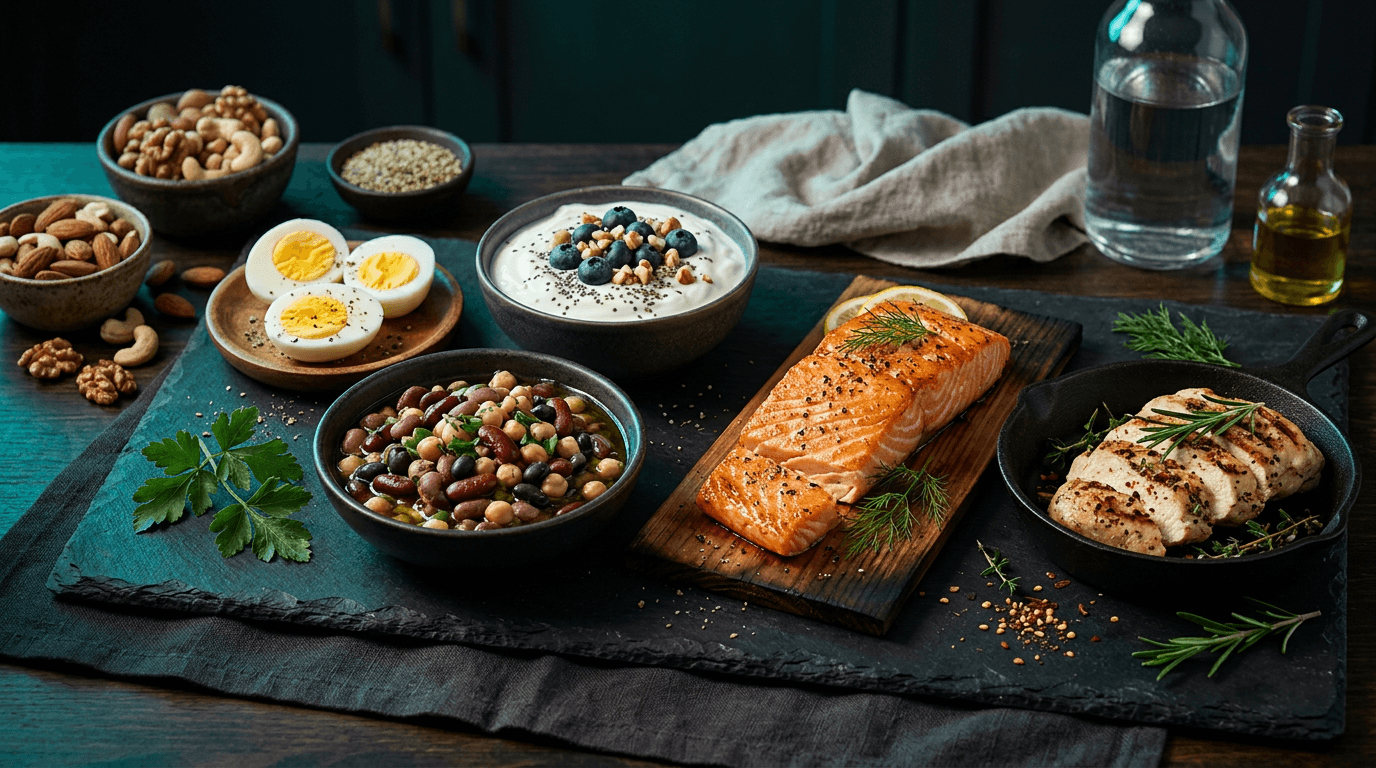
The internet is not short of protein advice. Bodybuilders will tell you to eat 3g per kilogram. Vegans will tell you most people eat too much. Government guidelines will tell you 0.8g per kilogram is fine. Your gym bro will tell you to drink a shake within 30 minutes of training or lose all your gains.
Most of this is wrong, or at least incomplete.
The actual science on protein requirements is more nuanced than any of these camps suggest, but it is also clearer than you might think. Here is what the research says, what it means for your goals, and how to actually hit your targets without turning meals into a maths exam.
The Problem With the RDA
The Recommended Dietary Allowance (RDA) for protein is 0.8g per kilogram of body weight per day. For a 75kg person, that is 60g of protein — roughly two chicken breasts.
This number is widely cited and almost universally misunderstood. The RDA is the minimum amount of protein needed to prevent deficiency in sedentary, healthy adults. It is not the optimal amount. It is not the recommended amount for anyone who exercises. It is the amount below which your body starts to struggle with basic functions.
Think of it like the minimum wage of nutrition. It keeps you alive. It does not help you thrive.
If you train regularly — whether that is weight training, running, cycling, team sports, or any form of structured exercise — your protein needs are significantly higher than the RDA. Your muscles are under more stress, your recovery demands are greater, and your body needs more raw material to rebuild.
What the Research Actually Says
The most comprehensive meta-analysis on protein intake for active people was published by Morton et al. (2018) in the British Journal of Sports Medicine. It analysed 49 studies with 1,863 participants and concluded:
For maximising muscle protein synthesis in resistance-trained individuals, the optimal range is 1.6 to 2.2g per kilogram of body weight per day.
That upper range of 2.2g/kg showed diminishing returns rather than additional benefit for most people. Beyond that, extra protein is simply oxidised for energy or excreted. It will not hurt you, but it will not help you build more muscle either.
For the 75kg person, that translates to 120-165g of protein per day. Double to nearly triple the RDA.
Protein Needs by Goal
Fat loss (in a caloric deficit): 1.8-2.4g/kg. When you are eating fewer calories than you burn, protein requirements actually go up, not down. Higher protein preserves lean muscle mass during a deficit, keeps you feeling fuller, and has a higher thermic effect (your body burns more calories digesting protein than carbs or fat). This is one of the best-supported findings in sports nutrition.
Muscle gain (in a surplus): 1.6-2.2g/kg. The classic bulking range. Enough protein to support new muscle growth combined with adequate calories and progressive training.
Maintenance: 1.4-1.8g/kg. If you are not trying to dramatically change your body composition but want to maintain what you have while staying active.
Endurance athletes: 1.2-1.6g/kg. Runners, cyclists, and swimmers have lower protein needs than strength athletes, but still well above the RDA. Endurance training causes muscle damage that requires repair, and protein helps maintain lean mass during high-volume training blocks.
Sedentary adults: 0.8-1.2g/kg. Even if you do not train, the evidence suggests the RDA minimum is barely adequate. Slightly higher protein intakes support better body composition, bone health, and metabolic function as you age.
Protein Timing: Does It Matter?
The "anabolic window" — the idea that you must consume protein within 30 minutes of training or miss out on gains — has been largely debunked. Research by Schoenfeld and Aragon (2018) found that the post-exercise window for protein synthesis is much wider than previously thought, lasting at least 4-6 hours.
What matters more than precise timing is total daily intake and distribution.
Distribution matters. Your body can only use a certain amount of protein for muscle protein synthesis at one time. Research suggests 0.4-0.55g per kilogram per meal as an optimal target, spread across 3-5 meals per day. For a 75kg person, that is roughly 30-40g per meal.
Eating 150g of protein in one massive dinner and nothing the rest of the day is less effective than spreading it across meals, even if the daily total is the same. Your body is not a bank account that just tallies the total — the rate of delivery matters.
Practical timing guidelines:
- Eat a protein-containing meal within a few hours before or after training. The exact timing is not critical.
- Spread protein across at least 3 meals per day.
- If you train fasted in the morning, have a protein-rich meal within a few hours post-training.
- A pre-sleep protein dose (casein or cottage cheese) may support overnight muscle protein synthesis, though the evidence is modest.
Protein Sources: Not All Created Equal
Complete vs Incomplete Proteins
A complete protein contains all nine essential amino acids in adequate amounts. Animal proteins (meat, fish, eggs, dairy) are all complete. Most plant proteins are incomplete, meaning they are low in one or more essential amino acids.
This does not mean plant protein is useless. It means you need to combine sources — rice and beans, hummus and pita, lentils and grains — to get the full amino acid profile. If you eat a varied plant-based diet, you will get all the essential amino acids. You just need to be more intentional about it.
Protein Quality Ranking
Tier 1 — Highest quality (complete, highly bioavailable):
- Eggs (often considered the gold standard)
- Whey protein
- Fish (especially salmon, tuna, hake)
- Chicken breast
- Lean beef
- Greek yoghurt / cottage cheese
Tier 2 — Good quality:
- Lean pork
- Turkey
- Milk
- Biltong and droewors (excellent protein density, watch the salt)
- Tinned fish (sardines, pilchards, tuna)
Tier 3 — Plant proteins (combine for completeness):
- Lentils and legumes
- Chickpeas
- Tofu and tempeh
- Quinoa (one of the few complete plant proteins)
- Soy protein isolate
- Pea protein
South African Protein Sources
Living in South Africa gives you some unique protein advantages:
Biltong and droewors. Gram for gram, biltong is one of the most protein-dense foods available. 100g of beef biltong contains roughly 55g of protein with minimal carbs. It is convenient, portable, and does not need refrigeration. The downside is sodium — biltong is heavily salted, so it should complement your diet rather than be your primary protein source.
Boerewors. Popular, tasty, and often eaten at braais — but it is not a great protein source. Boerewors is high in fat (often 25-30% fat content) and relatively lower in protein per calorie compared to leaner cuts. It is fine as part of a balanced diet, but do not count on it to hit your protein targets efficiently.
Tinned pilchards and sardines. Cheap, readily available, and packed with protein and omega-3 fatty acids. Two tins of Lucky Star pilchards provide roughly 40g of protein for under R40. Hard to beat on a budget.
Eggs. Still the most affordable complete protein source in South Africa. Six eggs provide approximately 36g of protein for around R20-25.
Chicken. South Africa produces affordable chicken compared to many countries. Buying whole chickens or bulk thighs from wholesale retailers is cost-effective.
Common Protein Mistakes
Mistake 1: Front-Loading All Protein at Dinner
Many South Africans eat a light breakfast (maybe toast or cereal), a sandwich for lunch, and then a massive dinner with a large piece of meat. This concentrates most of your protein in one meal. Your body cannot use 80g of protein for muscle synthesis in one sitting — the excess gets oxidised for energy. Spread it out.
Mistake 2: Counting Total Protein Without Checking Sources
"I eat a lot of protein" usually means "I eat a lot of food that contains some protein." Bread has protein. Rice has protein. But these are not efficient protein sources. Check how much protein per calorie you are getting, not just whether the food contains protein at all.
Mistake 3: Relying on Protein Shakes Exclusively
Whey protein is convenient and cost-effective per gram of protein. But it should supplement your diet, not replace whole food. Whole foods contain micronutrients, fibre, and other compounds that isolated protein powder does not. Use shakes to fill gaps, not as your primary source.
Mistake 4: Ignoring Protein During Fat Loss
When people cut calories, protein is often the first macro to drop — usually because high-protein foods are more expensive and take more effort to prepare than carb-heavy convenience foods. This is backwards. Protein should go up (or at least stay the same) during a cut. It preserves muscle, controls hunger, and has the highest thermic effect of any macronutrient.
Mistake 5: Thinking More is Always Better
Beyond 2.2-2.4g per kilogram, there is no additional muscle-building benefit. Excess protein is simply converted to glucose or excreted. It will not harm your kidneys if they are healthy, but it is an expensive way to get calories when carbs or fat would serve you better.
How to Hit Your Protein Target
For a 75kg person targeting 150g of protein per day, here is what a realistic day looks like:
Breakfast: 3 scrambled eggs on toast with a glass of milk = ~30g protein
Snack: 50g biltong = ~28g protein
Lunch: Grilled chicken salad with chickpeas = ~35g protein
Snack: Greek yoghurt with almonds = ~18g protein
Dinner: Grilled fish (150g hake) with sweet potato and vegetables = ~32g protein
Total: ~143g protein. Close enough. Add a protein shake post-training if you need the top-up.
The key is having protein at every meal, not trying to cram it all in at once.
Tracking Protein Without Obsessing
The challenge with hitting protein targets is knowing where you stand. Most people either obsessively weigh everything (unsustainable) or vaguely estimate ("I probably had enough"). Neither approach works long-term.
AI-powered food tracking has closed this gap. You can snap a photo of your meal or describe it in a few words and get a protein breakdown in seconds. No weighing. No database searching. No manual entry.
Penng tracks protein (along with all other macros) through five input methods: meal photos, barcode scanning, text descriptions, voice input, and nutrition label photos. Because the data lives alongside your recovery and sleep scores, you can actually see the relationship between your protein intake and how your body responds. High-protein days often correlate with better recovery scores — and once you see that pattern in your own data, hitting your target becomes self-motivating rather than a chore.
For people who find traditional food logging tedious, the difference between logging everything manually and having AI handle most of the work is the difference between a habit that lasts two weeks and one that actually sticks.
The Bottom Line
The RDA of 0.8g/kg is a survival minimum, not an optimal target. If you exercise regularly, the evidence strongly supports 1.6-2.2g per kilogram of body weight per day. During fat loss, aim for the higher end. Spread your intake across 3-5 meals. Prioritise quality sources. Do not stress about the exact timing.
Protein is probably the single most impactful macro to get right. It affects your muscle mass, your recovery, your satiety, and your body composition more directly than any other nutrient. The good news is that with some awareness and basic planning, hitting your target is entirely achievable — even on a South African budget.
Frequently Asked Questions
Is 0.8g of protein per kilogram enough?
The RDA of 0.8g/kg is the minimum to prevent deficiency in sedentary adults. If you exercise regularly, research consistently shows you need more — 1.6 to 2.2g per kilogram for optimal muscle protein synthesis and recovery. Even non-exercising adults may benefit from slightly higher intakes of 1.0-1.2g/kg.
Can you eat too much protein?
For healthy individuals, protein intakes up to 2.4g/kg show no adverse effects on kidney function. Beyond about 2.2g/kg, you are unlikely to see additional muscle-building benefits — the excess is simply used for energy. If you have pre-existing kidney disease, consult a healthcare professional about your protein intake.
Do I need protein immediately after training?
The "30-minute anabolic window" has been largely overstated. Research shows the post-exercise window for muscle protein synthesis lasts at least 4-6 hours. What matters most is total daily protein intake distributed across multiple meals. That said, having a protein-containing meal within a few hours of training is still a sensible practice.
Is plant protein as good as animal protein for muscle building?
Plant proteins can absolutely support muscle growth, but they require more planning. Most plant sources are incomplete proteins (lacking one or more essential amino acids), so you need to combine sources — legumes with grains, for example. Plant proteins also tend to have lower leucine content, the amino acid that most directly stimulates muscle protein synthesis. To compensate, aim for the higher end of the protein range (2.0-2.2g/kg) on a plant-based diet.
What are the best budget protein sources in South Africa?
Eggs are the most affordable complete protein — six eggs provide about 36g of protein for around R20-25. Tinned pilchards and sardines are another excellent budget option. Buying chicken in bulk (whole chickens or thigh portions from wholesale retailers) is cost-effective. Dried lentils and chickpeas provide good plant-based protein at very low cost per serving.
Take the free quiz at penng.ai/quiz to find out how your protein intake compares to what your body actually needs based on your training and goals.