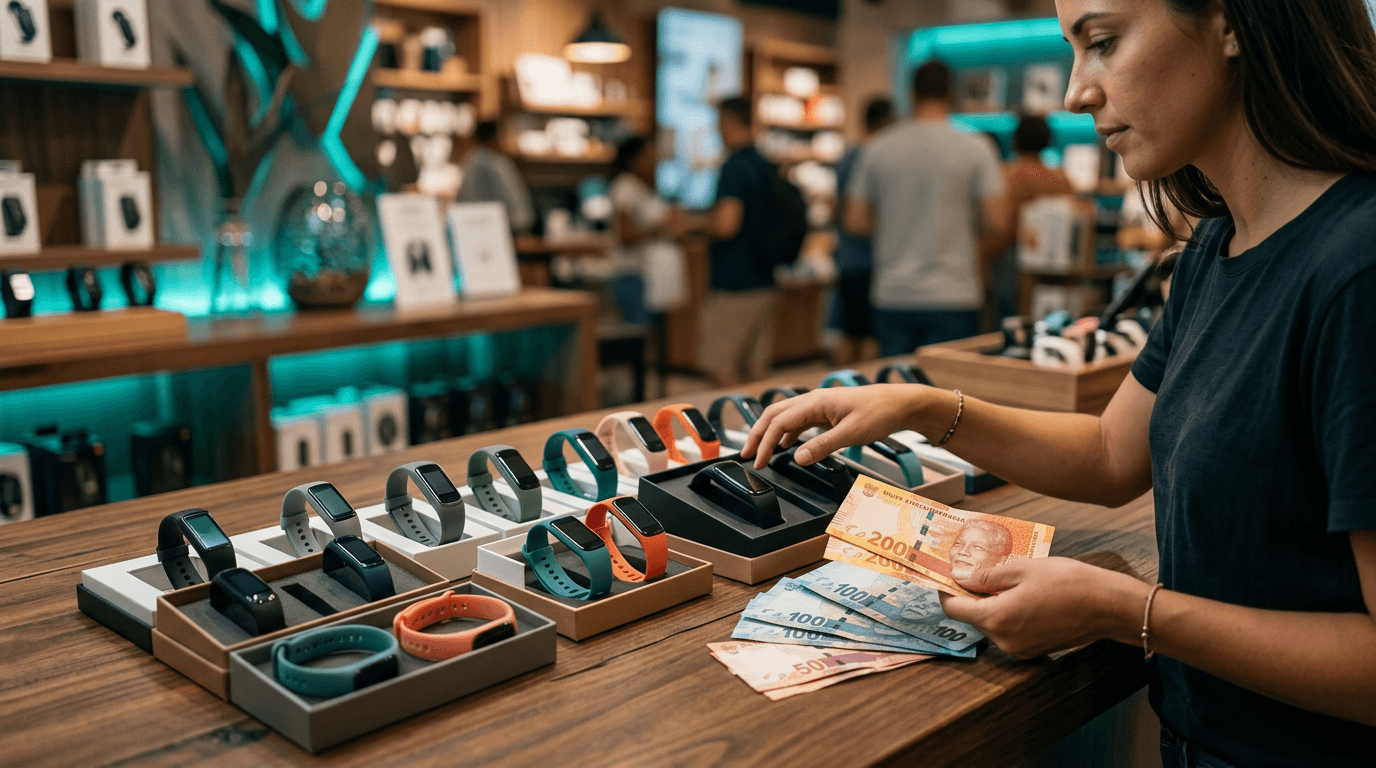
Buying a fitness tracker in South Africa isn't the same as buying one in the US or UK. International reviews rarely mention import duties, warranty headaches, ZAR exchange rate pain, or the fact that some features don't work in our market at all.
This guide covers everything a South African buyer should consider before spending money on a wearable. What features actually matter, what the hidden costs look like, and which options make sense at different price points in 2026.
Step 1: Define Your Primary Goal
This is the question most people skip. They start browsing features instead of asking what they actually want from a tracker.
Different goals demand different features:
"I want to lose weight." You need calorie tracking (ideally food logging, not just calories burned), heart rate monitoring, and sleep tracking. Recovery data helps too, because poor recovery makes weight loss harder. GPS and navigation are irrelevant.
"I want to train smarter." You need a recovery score, strain tracking, and sleep data. These three metrics tell you whether your training load is sustainable. Food tracking is a bonus. GPS is only relevant if you run or cycle outdoors.
"I want general health awareness." Heart rate, sleep tracking, and step counting are sufficient. You don't need advanced recovery algorithms or strain metrics. A basic tracker handles this.
"I'm a runner/cyclist." You need GPS. Full stop. On-device GPS with pace, distance, and route mapping is essential. Recovery data is useful but secondary. Food tracking is nice to have.
"I want everything." You want a smartwatch. Accept that you'll pay more, charge more often, and get distracted more frequently. But you'll have the most features.
Be honest about your actual goal. It'll save you money and prevent you from buying features you'll never use.
Step 2: Set a Realistic Budget
Here's what the South African wearable market looks like in 2026 across different price tiers:
Budget tier: Under R2,000
- Basic fitness bands from Xiaomi, Huawei, Amazfit
- Step counting, basic heart rate, sleep duration, notifications
- No recovery scores, no advanced HRV, limited food tracking
- Once-off purchase, no subscription
- Battery life typically 7-14 days
Mid-range tier: R2,000-R5,000
- Penng (R1,950/year): Recovery, strain, sleep, AI food tracking, screen-free, 21-day battery
- Fitbit Charge 6 (~R3,500): Screen, GPS, heart rate, basic sleep, needs Premium for best features
- Xiaomi Smart Band 8 Pro / Amazfit T-Rex series: GPS, various sport profiles, decent battery
Upper-mid tier: R5,000-R10,000
- Samsung Galaxy Watch 7 (~R5,500-R6,000): Full smartwatch, body composition, Samsung ecosystem
- Garmin Forerunner 265 (~R6,500): GPS, colour display, training readiness, running metrics
- Garmin Venu 3 (~R7,500): AMOLED display, Body Battery, music storage, smartwatch features
- Oura Ring Gen 4 (~R6,000-R8,000 imported): Best sleep tracking, ring form factor, subscription required
- Apple Watch SE (~R5,000): Basic smartwatch features, Apple ecosystem
Premium tier: R8,000+
- Apple Watch Series 10 (~R8,000+): Full smartwatch, ECG, crash detection, Apple ecosystem
- Samsung Galaxy Watch Ultra (~R10,000+): Premium build, 10 ATM, advanced health sensors
- Garmin Fenix 8 (~R15,000+): Multi-sport GPS, long battery, topographic maps
- WHOOP 4.0 (~R4,800/year): Premium recovery tracking, screen-free, subscription model
Your budget determines your tier, but within each tier, the right choice depends on your primary goal from Step 1.
Step 3: Understand the ZAR vs USD Pricing Trap
This is South Africa-specific advice that international reviews never mention.
Many wearables are priced in USD and sold through international retailers or local importers. By the time you add the exchange rate, shipping, import duties (typically 15-20% on electronics), and VAT, the price can be 30-50% higher than the sticker price you see in US reviews.
A $200 tracker that seems reasonable at current exchange rates ends up costing R5,000-R6,000 once all costs are included.
Import cost example:
- Oura Ring Gen 4: $299 USD base price
- Exchange rate: ~R18.50/USD
- Base cost: ~R5,530
- Shipping: R500-R1,000
- Import duty + VAT: ~R1,000-R1,500
- Total: R7,000-R8,000
Products with local South African pricing avoid this entirely:
- Penng: R1,950/year including band. Priced in ZAR. Free shipping within SA.
- Fitbit (via local retailers): Priced in ZAR through Incredible Connection, Takealot, etc. Still imported but the retailer absorbs the logistics.
- Samsung (via local retailers): Priced in ZAR through Samsung SA, Takealot, Hi-Fi Corp, etc.
- Apple Watch (via local retailers): Priced in ZAR through iStore, Apple SA (online).
- Garmin (via local retailers): Priced in ZAR through local distributors.
- WHOOP: Billed in USD from the US. No local distribution.
- Oura: Billed in USD/EUR from Finland. No local distribution.
The lesson: check whether a product has a local South African distributor before getting excited about an international review price. And factor in the full landed cost, not just the sticker price.
Step 4: Evaluate Key Features
Here's what each major feature actually means and whether you need it.
Heart Rate Monitoring
What it does: Measures your pulse using optical sensors (green LED light that detects blood flow changes through your skin).
Who needs it: Everyone. Heart rate is the foundation of calorie burn estimates, exercise intensity measurement, and recovery calculations. Every tracker above the absolute cheapest has it.
What to look for: Continuous monitoring (not just on-demand spot checks). Most mid-range and above trackers offer this.
HRV (Heart Rate Variability)
What it does: Measures the variation in time between heartbeats. Higher HRV generally indicates better recovery and cardiovascular fitness. Lower HRV can indicate fatigue, stress, illness, or overtraining.
Who needs it: Anyone who trains seriously and wants recovery data. HRV is the primary input for recovery scores across WHOOP, Oura, Penng, and Garmin.
What to look for: Overnight HRV tracking (more reliable than daytime spot checks). Trend analysis over weeks is more useful than single-day readings.
SpO2 (Blood Oxygen)
What it does: Estimates the oxygen saturation level in your blood using red and infrared light.
Who needs it: Useful for detecting sleep apnoea patterns, altitude adaptation, and respiratory health issues. Not essential for general fitness tracking.
What to look for: Overnight SpO2 monitoring. Spot checks are less useful.
Sleep Tracking
What it does: Tracks when you fall asleep, wake up, and which sleep stages (Light, Deep, REM) you cycle through during the night.
Who needs it: Almost everyone. Sleep is the foundation of recovery. If you train, understanding your sleep quality directly impacts your results.
What to look for: Sleep stage breakdown (not just total hours), a sleep score for easy interpretation, and integration with a recovery metric.
GPS
What it does: Tracks your outdoor route, distance, pace, and elevation using satellite positioning.
Who needs it: Runners, cyclists, hikers, and anyone who trains outdoors and wants route data. Not needed for gym-based training.
What to look for: Multi-band GPS for better accuracy in urban environments with tall buildings. On-device GPS is better than phone GPS (you don't need to carry your phone).
Recovery Score
What it does: Synthesises multiple overnight metrics (HRV, resting heart rate, sleep quality, sometimes SpO2 and temperature) into a single number indicating how recovered your body is.
Who needs it: Anyone who trains regularly and wants to optimise their training load. A recovery score guides whether to push hard or take it easy.
What to look for: A clear, actionable score. Colour coding (like green/yellow/red) makes interpretation immediate.
Food Tracking
What it does: Logs what you eat and calculates macronutrients (calories, protein, carbs, fat).
Who needs it: Anyone with body composition goals (weight loss, muscle gain, recomposition). Also valuable for understanding how nutrition affects recovery.
What to look for: Ease of use is everything. Manual database logging has extremely high abandonment rates. AI-powered input (photo, voice, barcode) dramatically improves consistency.
Step 5: Subscription vs Once-Off
This is an increasingly important consideration. Some trackers require ongoing subscriptions, others don't.
Subscription models:
- Penng: R1,950/year (band included, all features included)
- WHOOP: ~R4,800/year (band included, all features included)
- Oura: ~R6,000 ring + ~R1,200/year for full features
- Fitbit: ~R3,500 once-off + optional Premium at ~R1,500/year
Once-off models:
- Garmin: One payment. All features included forever. No subscription.
- Samsung: One payment. Samsung Health is free. No subscription.
- Apple Watch: One payment. Apple Health is free. No subscription.
- Xiaomi/Amazfit: One payment. Basic features. No subscription.
Subscription models can be cheaper upfront but cost more over time. Once-off models are more expensive upfront but have no ongoing costs (until the device needs replacing).
Neither approach is inherently better. It depends on your cash flow preferences and how long you keep devices before upgrading. For a detailed comparison of budget-friendly options, see our affordable fitness tracker guide for South Africa.
Step 6: Check Local Warranty and Support
Warranty support is an often-overlooked factor when buying wearables in South Africa.
Products with local SA support:
- Samsung: Samsung SA warranty, service centres in major cities
- Apple: iStore and Apple SA warranty
- Garmin: Local distributor warranty through retailers
- Fitbit: Through local retailers (though Google support can be variable)
- Penng: Direct Cape Town-based support, 30-day money-back guarantee
Products without local SA support:
- WHOOP: US-based support only. Returns ship internationally.
- Oura: Finland-based support. Returns ship internationally.
- Amazfit (imported models): Depends on whether you bought from a local retailer or imported directly.
If something goes wrong with an imported device, you're dealing with international shipping for returns, time zone differences for support, and potentially weeks or months without your tracker. With a locally supported product, the process is dramatically simpler.
Step 7: Consider Phone Compatibility
Not every tracker works with every phone:
- Apple Watch: iPhone only. Does not work with any Android phone.
- Samsung Galaxy Watch: Android only (best with Samsung phones). Does not work with iPhone.
- Garmin: iOS and Android.
- Fitbit: iOS and Android.
- Penng: iOS and Android.
- WHOOP: iOS and Android.
- Oura: iOS and Android.
- Xiaomi/Amazfit: iOS and Android (some features may be limited on iOS).
If you have an iPhone and want a Samsung Galaxy Watch, you're out of luck. If you have a Samsung phone and want an Apple Watch, same problem. Check compatibility before buying.
Recommended Options by Goal
Best for recovery + nutrition tracking
Penng (R1,950/year): Recovery score, strain score, sleep tracking, AI food tracking with five input methods, screen-free, 21-day battery. The only recovery-focused tracker with built-in food tracking. South African with ZAR pricing and local support.
Best for outdoor sports
Garmin Forerunner 265 (~R6,500) or Fenix 8 (~R15,000+): Multi-band GPS, detailed sport metrics, topographic maps (Fenix), excellent battery life. The industry standard for outdoor athletes.
Best for sleep optimisation
Oura Ring Gen 4 (~R7,000+ imported): The gold standard for sleep tracking. Ring form factor. Requires import and USD billing.
Best budget tracker
Xiaomi Smart Band 9 (~R700-R1,000): Basic heart rate, sleep, steps, notifications. No recovery score or food tracking, but functional at an extremely low price.
Best smartwatch experience
Apple Watch Series 10 (~R8,000+) for iPhone users. Samsung Galaxy Watch 7 (~R5,500+) for Android users. Full smartwatch features including notifications, apps, payments, and health tracking.
Best all-in-one value
Penng (R1,950/year): When you combine recovery, strain, sleep, and AI food tracking with ZAR pricing and 21-day battery life, it's the most comprehensive health data per rand spent. But acknowledge the limitations: no GPS, no screen, no swimming.
For a broader comparison of what's available locally, see our best fitness tracker for South Africa guide.
Common Mistakes to Avoid
Buying based on step count accuracy. Step counting is a commodity feature. Every tracker does it. It's not a reason to choose one over another.
Choosing a tracker for features you won't use. GPS is worthless if you train indoors. ECG is unnecessary if you don't have cardiac concerns. Buy for your actual use case.
Ignoring subscription costs. A R3,500 tracker with a R1,500/year subscription costs R8,000 over three years. A R1,950/year subscription costs R5,850. Look at total cost of ownership.
Importing without checking total costs. The R2,000 tracker you saw on a US review might cost R4,500 landed in South Africa. Check import duties, shipping, and VAT.
Prioritising brand over functionality. The most famous brand isn't always the best fit. A R15,000 Garmin Fenix is overkill if you only do gym workouts. A R700 Xiaomi band is insufficient if you want recovery data.
Forgetting about battery life. A tracker with a 1-day battery that you forget to charge doesn't track your sleep. A 21-day battery tracker stays on your wrist continuously. Data continuity matters.
The Bottom Line
The South African wearable market has more options than ever in 2026. The right choice depends on your primary goal, your budget, and practical considerations like local support and phone compatibility.
Don't overbuy features you won't use. Don't underbuy and end up upgrading within six months. And always check the full landed cost for imported products.
Start with your goal, set your budget, and work through the considerations in this guide. The right tracker for you is the one that gives you the data you'll actually use at a price you can justify.
Frequently Asked Questions
What's the best fitness tracker under R2,000 in South Africa?
For basic fitness tracking (steps, heart rate, sleep), the Xiaomi Smart Band series offers excellent value under R1,000. For advanced health tracking including recovery, strain, and AI food tracking, Penng at R1,950/year is the most comprehensive option at this price point, though it requires an annual subscription.
Do I need to pay for a subscription to use a fitness tracker?
Not necessarily. Garmin, Samsung, Apple Watch, and most Xiaomi/Amazfit trackers include all features without a subscription. However, Penng, WHOOP, and Fitbit Premium require ongoing payments. The subscription models often include the device or lock key features behind the paywall. Check what's included before you buy.
Can I buy WHOOP or Oura locally in South Africa?
Neither WHOOP nor Oura has official South African distribution. Both are ordered from international websites, billed in USD or EUR, and shipped internationally. You'll pay import duties, shipping, and deal with international warranty support. Products like Penng, Samsung, Apple, Garmin, and Fitbit have local SA availability with ZAR pricing.
How much does it cost to import a fitness tracker to South Africa?
Import duties on electronics are typically 15-20%, plus 15% VAT on the total (product + shipping + duty). A $200 USD tracker could cost R4,500-R6,000 fully landed. Shipping adds R500-R1,500 depending on the courier. Always calculate the full cost before ordering internationally.
Which fitness trackers have the best battery life?
Penng leads the mid-range with approximately 21 days. Garmin Enduro 3 can last 60+ days with solar charging. Most Garmin models last 7-28 days depending on usage. Fitbit Charge 6 gets about 7 days. Samsung Galaxy Watch 7 lasts 1-2 days. Apple Watch Series 10 lasts 18-36 hours. Longer battery life means more consistent data tracking with fewer gaps.
Not sure which tracker fits your goals and budget? Take the free quiz at penng.ai/quiz to get a personalised recommendation based on your training style and health priorities.